



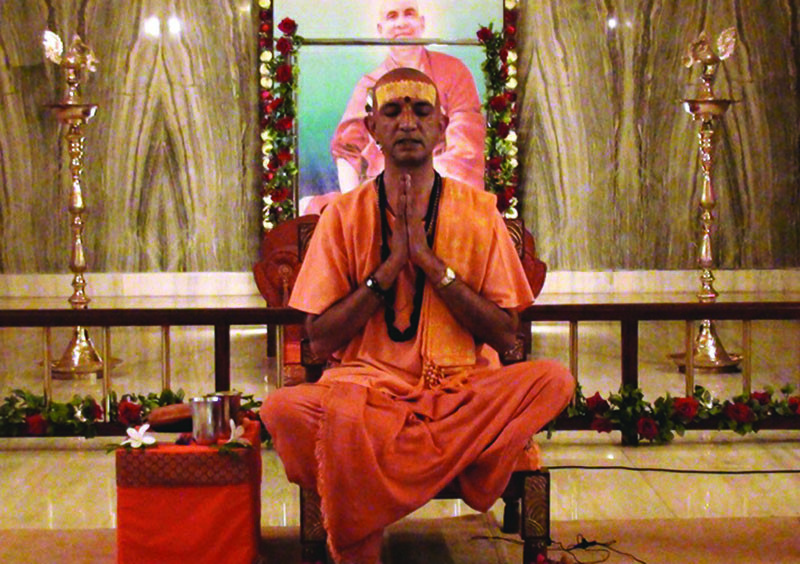

We celebrate the eighth of September as the birthday of our Paramguru Swami Sivananda Saraswati. Swami Sivananda represents a force of transformation in the chapter of humanity in the twentieth century. He was not only a sannyasin, a renunciate, a sadhu, not only a doctor, not only a good person, he was unique and outstanding in the pantheon of Indian sannyasins.
Normally sannyasa is a vocation in life, and in order to live sannyasa one has to be very clear that this path is to unite with the highest self within one. That is the purpose of sannyasa, not the adoption of a particular vocation, not to fulfil a cherished desire, not to become part of or a member of a group.
Sannyasa represents a process of upliftment, of realizing the dormant divinity within. This is the reason why people come to sannyasa.
Over a period of time in human history, sannyasa has been defined in different ways. For some it is a process of jnana yoga, knowing the self through the intellect. For some it is realizing the source inside by channelling the emotions through bhakti.
For some it is realizing the harmony that can exist within, in the individual's microscopic world and life, the manifest world and life, and the divine, transcendental world and life, the harmony that can be experienced and lived in all these dimensions by balancing one's karmas.
However, regardless of the path chosen, the aim of sannyasa has been to uplift oneself and realize the divinity inside.

Swami Sivananda lived the life of a sannyasin. He lived what he believed in, what he taught and preached. There was no difference between his actions and his innermost feelings.
Maturity in spiritual life is like boiling a potato. In its natural form a potato is hard, but when you boil it in water, the natural, hard form is transformed into a soft form which can be eaten and enjoyed. In the same way, with spiritual illumination it is the breaking down and splitting open of the hard shell of the ego that brings out the pure self.
In order to bring out the pure self, one requirement is to be simple in needs, thoughts, attitudes and behaviour. When the thoughts are complex and intricate, they cause frustrations and difficulties in adjusting to life.
Then all human effort is directed to finding some balance in this disharmony, whether it is divine or a search for security, happiness, contentment, satisfaction, peace and fulfilment. Inner harmony and purity are reflected when one becomes simple, and not crooked and devious.
As you become simple, less selfish and egotistical, you become humble. Humility is a quality seen in the lives of luminaries in the world. Swami Sivananda represents this ideal.
Ganga darshan, September 8, 2002
From “Yoga Magazine”, Issue September 2003, Sw Niranjananda Saraswati