



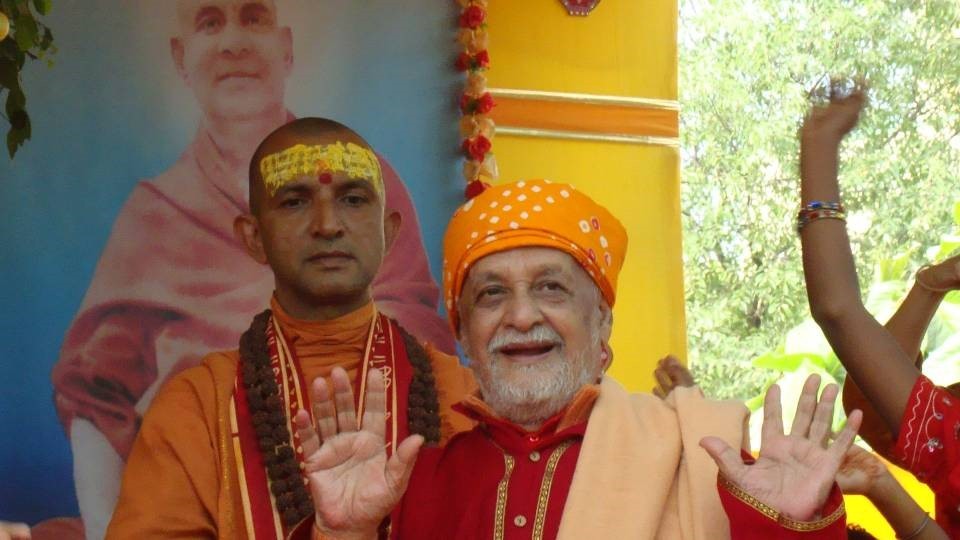

It was only in the last fifty years that visionary sadhus felt that yoga was going to be the need of society in the future. In the Northern school of yoga the person who set the ball rolling was our paramguru, Swami Sivananda. He gave yoga a dynamic twist, bringing it out from philosophy and into practice.
Although the Dashnami sannyasa parampara to which we belong follows a Vedantic tradition, not a yogic one, in the early 1940's Swami Sivananda started training his sannyasin disciples in the practicalities of yoga.
He taught them hatha yoga, raja yoga, bhakti yoga, jnana yoga, kriya yoga, kundalini yoga, mantra yoga, every kind of yoga as found in the scriptures. Swami Sivananda gave an understanding of yoga to everyone as a way to further develop their own lives, either as sannyasins, as yogis or as householders.
His teaching was so inspiring that many of his sannyasin disciples emerged from the ashram with mandates to propagate yoga. Each disciple emphasized a particular theme. Swami Satchidananda, who founded the Integral Yoga Movement in the USA, emphasized components of hatha yoga, jnana yoga and bhakti yoga. Swami Vishnudevananda, whose main centre is in Canada, established many Sivananda Yoga Vedanta centres teaching hatha yoga. Swami Venkateshananda taught raja yoga in Mauritius.
Our guru, Swami Satyananda, who was also given a mandate to teach yoga as part of his sadhana in life, emphasized integral yoga, components of all the yogas, with more emphasis on tantric yoga.
This system of tantric yoga involves the practice of kundalini yoga, kriya yoga, mantra yoga, laya yoga, the advanced stages of pratyahara and dharana, and the advanced stages of dhyana and samadhi. From the vedic side, Sri Swamiji took the components of bhakti yoga, karma yoga, jnana yoga, and the concept of the chakras, and developed a system of meditation.
He took the system of meditation from the tantras and the Vedas and these meditations were later published in 1974 in the book Meditations from the Tantras. The initial teachings were published in 1965 in the book Mechanics of Meditation: Practices for Peace.

Sri Swamiji was the first person to bring the yogic side of tantra to the forefront. As far back as 1971 a book named Tantra Yoga Panorama was published in which Sri Swamiji explained the concepts of tantra as applicable to the needs of today's society.
Swami Satyananda inspired people to come to terms with themselves through right and discriminative behaviour, action and speech, thus bringing about a transformation of human personality.
When Sri Swamiji first founded the Bihar School of Yoga, it was as the culmination of a wish of Swami Sivananda's to develop an integrated path of yoga. As Sri Swamiji was pioneering the bringing of yoga to the public at large and the breaking down of old myths, outside India this Bihar Yoga system is known as the Satyananda Yoga tradition.
Satyananda yoga is an evolving yoga; it is a school where a concept is developed. When yoga becomes a part of the human environment, the human need and eventually a part of human life and culture, then it becomes universal and dynamic, progressive and inspiring.
Satyananda Yoga, also known as Bihar Yoga, fits into this category. It is an evolving yoga. The ancient traditions are continually being looked into and the knowledge brought out into the open, not on any one specific subject, but on the total development of human nature and personality in yoga.
From “Yoga Magazine, Issue January 2000, The growth of Satyananda Yoga or Bihar Yoga”, Sw. Niranjanananda Saraswati