






Just as there are qualifications and duties of a disciple, there is also the duty of a guru as it is the same disciple who eventually, by overcoming the six ‘friends’, gradually steps into the shoes of the master.

It is the same disciple, the same aspirant, the same individual who started off with all the good and negative things in the package. With the effort made to empty the negative from the package and put in the positive, he continues to walk along the path and eventually finds that he has overcome the influence of the six friends.

He is now stepping into the shoes of a guru and becoming the inspiration and the teacher. So, it is the same individual, who has travelled the path, who adopts the natural role of the teacher.

The guru has three roles: the first one is teacher, second is advisor and the third is inspirer. As a teacher, he gives you specific techniques, processes and systems which you can apply to improve your conditions in life.

As an advisor, he gives advice on the sequence and progression of the student’s efforts and sadhana. He keeps you motivated to walk the right path: as a teacher when he is nearby; as an advisor when he is far away; and as an inspirer after the disciple has gained the ability to be independent.

These are the three duties of a guru, nothing more than that. What other role can there be? Any siddhi is a personal achievement, it is not the duty, role or dharma of the teacher or guru to express that. When we look at the classical examples of guru, we see these three roles.

One of the functions of the guru is to empower you as the disciple to take responsibility for yourself with wisdom, clarity and understanding. This is the natural condition in life which should appear after you have overcome the limitations of your own mind.

Guru is a reminder and helper to point out, ‘Listen, this is what you have to achieve. You have to take responsibility with wisdom, clarity and understanding’.

The teaching of the guru is to ensure that you follow the path of your dharma – a soldier should be a soldier, an engineer should be an engineer, a doctor should be a doctor, a plumber should be a plumber – and to ensure that we all walk our dharma, that we all live our dharma in the best manner possible with happiness, joy and peace.

To overcome the six friends, we have to think about changing our lifestyle. Asana, pranayama and meditation will not take us there. This change can only happen by trying to identify the good, virtuous and positive in life and applying these qualities, one at a time.

That is the purpose of yama and niyama. That is where the guru intervenes and tells you that to manage the six friends, you have to develop this state of mind, this condition of mind, and overcome cravings, desires and needs. By living manahprasad and just by being happy, you will discover that your needs reduce only due to the simple fact that you are happy.

The role of guru in life is to make us connect with the virtuous and the positive, to experience and enhance our own beauty and to connect with Satyam, to experience Sundaram and to be Shivam. That is the journey between guru and disciple.

Guru Poornima, 30 July 2015, Paduka Darshan, Munger

From “Yoga Magazine, Issue July 2021, Journey between Guru and Disciple“, Sw Niranjanananda Saraswati


Satyanandashram Hellas

Alithias 1, 19002 Paiania, Greece

PO Box 22, 19002 Paiania, Greece

+30 210 6644189, +30 210 6028531

info@satyanandayoga.gr

Paiania Meditation Center

Dimarchou Iona Vore (former Diadochou Konstantinou) 32, 19002 Paiania

+30 210 6641545, 695 6482415

sycp@satyanandayoga.gr

Athens Meditation Center

Simetelou 2, 115 28, Athens

210 3311178, 694 2974467

syca@satyanandayoga.gr

Thessaloniki Meditation Center

Proxenou Koromila 1, 54623 Thessaloniki

+30 2310 283109

sycs@satyanandayoga.gr

The trademark Satyanandashram Hellas CENTER OF YOGA® is a trademark owned by Satyanandashram Hellas, Greece and used with permission.
The term SATYANANDA YOGA® is a trademark owned by IYFM and used with permission.
Satyananda Yoga Nidra® is a registered trademark of IYFM used with permission.

How you can be part of this beautiful community of service

You are welcome to come and unite in our efforts to help us accomplish our aims and goals. Our association needs people who are ready to offer their hearts, their skills and ideas as well as monetary contributions, and to integrate their ‘head, heart and hands’ in service.

If you consider the needs of others, we need you.
If you have a generous heart, we need you.
Ιf you have large hands, we need you.
If you have bright ideas, we need you.

Your contributions allow us to reach out to more and more people. Your contributions enable us to support and work towards the fulfilment of the vision of Swami Satyananda, Swami Niranjanananda and their lineage  that of peace and prosperity for all humankind.

X

The guru’s duty and role

Just as there are qualifications and duties of a disciple, there is also the duty of a guru as it is the same disciple who eventually, by overcoming the six ‘friends’, gradually steps into the shoes of the master.

It is the same disciple, the same aspirant, the same individual who started off with all the good and negative things in the package. With the effort made to empty the negative from the package and put in the positive, he continues to walk along the path and eventually finds that he has overcome the influence of the six friends.

He is now stepping into the shoes of a guru and becoming the inspiration and the teacher. So, it is the same individual, who has travelled the path, who adopts the natural role of the teacher.

The guru has three roles: the first one is teacher, second is advisor and the third is inspirer. As a teacher, he gives you specific techniques, processes and systems which you can apply to improve your conditions in life.

As an advisor, he gives advice on the sequence and progression of the student’s efforts and sadhana. He keeps you motivated to walk the right path: as a teacher when he is nearby; as an advisor when he is far away; and as an inspirer after the disciple has gained the ability to be independent.

These are the three duties of a guru, nothing more than that. What other role can there be? Any siddhi is a personal achievement, it is not the duty, role or dharma of the teacher or guru to express that. When we look at the classical examples of guru, we see these three roles.

One of the functions of the guru is to empower you as the disciple to take responsibility for yourself with wisdom, clarity and understanding. This is the natural condition in life which should appear after you have overcome the limitations of your own mind.

Guru is a reminder and helper to point out, ‘Listen, this is what you have to achieve. You have to take responsibility with wisdom, clarity and understanding’.

The teaching of the guru is to ensure that you follow the path of your dharma – a soldier should be a soldier, an engineer should be an engineer, a doctor should be a doctor, a plumber should be a plumber – and to ensure that we all walk our dharma, that we all live our dharma in the best manner possible with happiness, joy and peace.

To overcome the six friends, we have to think about changing our lifestyle. Asana, pranayama and meditation will not take us there. This change can only happen by trying to identify the good, virtuous and positive in life and applying these qualities, one at a time.

That is the purpose of yama and niyama. That is where the guru intervenes and tells you that to manage the six friends, you have to develop this state of mind, this condition of mind, and overcome cravings, desires and needs. By living manahprasad and just by being happy, you will discover that your needs reduce only due to the simple fact that you are happy.

The role of guru in life is to make us connect with the virtuous and the positive, to experience and enhance our own beauty and to connect with Satyam, to experience Sundaram and to be Shivam. That is the journey between guru and disciple.

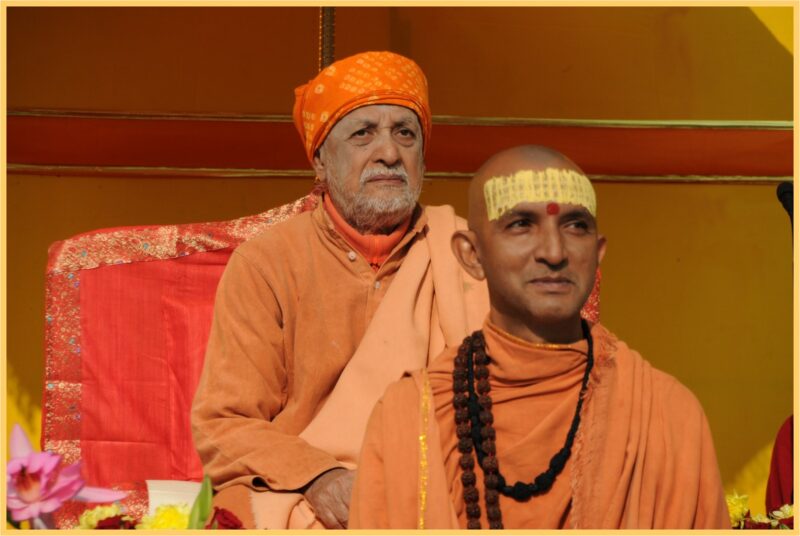
Guru Poornima, 30 July 2015, Paduka Darshan, Munger

From “Yoga Magazine, Issue July 2021, Journey between Guru and Disciple“, Sw Niranjanananda Saraswati