




It is said that Shiva’s nirakara form is that of the Shivalingam. The Shivalingam is a symbol not only of Shiva, but it is the joint symbol of Shiva and Shakti. Shakti resides in Shiva, as Shakti is born of the Self of Shiva. Therefore, the Shivalingam has both Shiva and Shakti established in it.

It has been called a lingam because during laya or dissolution, the entire creation merges and dissolves back into the lingam. The cause of laya is called the lingam. The Shivalingam has a part that extends upwards, and this is the symbol of the Shiva tattwa. The other part, the base called peeth or argha, is the symbol of Shakti.

Shakti also manifests herself in the Shivalingam in two other forms. In the lingam, she manifests as kalaa, creative expression of the intellect, and in the argha as bhakti, creative expression of emotions. Shiva also exhibits two forms in the lingam: the destroyer and the base of creation.

The argha is the symbol of the foundation of creation and the lingam is the symbol of its dissolution. In this way, the Shivalingam is the symbol of both Shiva and Shakti; it is not only a symbol of Shiva, which is how it is normally understood. It has the form and the image of both Shiva and Shakti. It is the symbol of the nirakara or the formless nature of Shiva and Shakti.

In the end, the formless also has to be experienced, and how is it possible to experience it without a symbol? Our guru, Swami Satyananda, says that in order to climb up to the roof, you need a ladder. Once you have reached the roof, throw the ladder away, as it is no longer needed.

In the same way, in order to experience the nirakara or the formless, in the beginning it is necessary to have a sakara symbol. Sri Swamiji says that if you accept only the formless God and do not accept the different forms, it is an insult to the omniscience and omnipresence of God.

If God is omnipresent and omniscient then he is everywhere, whether with form or without. If you accept God only as nirakara and negate his sakara aspect then that God cannot be pooma, complete.

This is why in the Indian tradition and philosophy, sakara has been accepted as more important than nirakara, as this is the path that can take you to your ishta. It is for this purpose that Shiva and Shakti have manifested their nirakara form as the Shivalingam.


Baidyanatheshwar Shankarbag, 19 February 2009


From the book “Shiva Charitra Narratives of Shiva”, pg.186-187, Sw Niranjanananda Saraswati

Satyanandashram Hellas

Alithias 1, 19002 Paiania, Greece

PO Box 22, 19002 Paiania, Greece

+30 210 6644189, +30 210 6028531

info@satyanandayoga.gr

Paiania Meditation Center

Dimarchou Iona Vore (former Diadochou Konstantinou) 32, 19002 Paiania

+30 210 6641545, 695 6482415

sycp@satyanandayoga.gr

Athens Meditation Center

Simetelou 2, 115 28, Athens

210 3311178, 694 2974467

syca@satyanandayoga.gr

Thessaloniki Meditation Center

Proxenou Koromila 1, 54623 Thessaloniki

+30 2310 283109

sycs@satyanandayoga.gr

The trademark Satyanandashram Hellas CENTER OF YOGA® is a trademark owned by Satyanandashram Hellas, Greece and used with permission.
The term SATYANANDA YOGA® is a trademark owned by IYFM and used with permission.
Satyananda Yoga Nidra® is a registered trademark of IYFM used with permission.

How you can be part of this beautiful community of service

You are welcome to come and unite in our efforts to help us accomplish our aims and goals. Our association needs people who are ready to offer their hearts, their skills and ideas as well as monetary contributions, and to integrate their ‘head, heart and hands’ in service.

If you consider the needs of others, we need you.
If you have a generous heart, we need you.
Ιf you have large hands, we need you.
If you have bright ideas, we need you.

Your contributions allow us to reach out to more and more people. Your contributions enable us to support and work towards the fulfilment of the vision of Swami Satyananda, Swami Niranjanananda and their lineage  that of peace and prosperity for all humankind.

X

Shivalingam

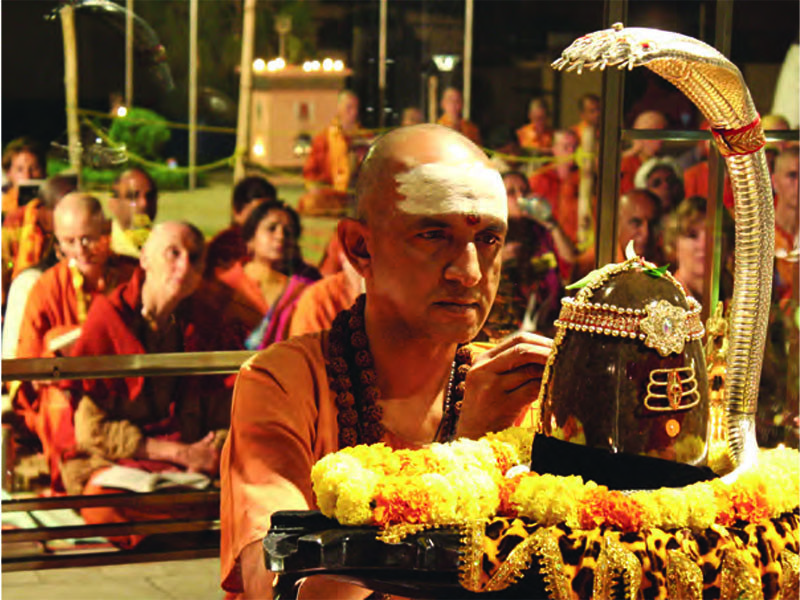
It is said that Shiva’s nirakara form is that of the Shivalingam. The Shivalingam is a symbol not only of Shiva, but it is the joint symbol of Shiva and Shakti. Shakti resides in Shiva, as Shakti is born of the Self of Shiva. Therefore, the Shivalingam has both Shiva and Shakti established in it.

It has been called a lingam because during laya or dissolution, the entire creation merges and dissolves back into the lingam. The cause of laya is called the lingam. The Shivalingam has a part that extends upwards, and this is the symbol of the Shiva tattwa. The other part, the base called peeth or argha, is the symbol of Shakti.

Shakti also manifests herself in the Shivalingam in two other forms. In the lingam, she manifests as kalaa, creative expression of the intellect, and in the argha as bhakti, creative expression of emotions. Shiva also exhibits two forms in the lingam: the destroyer and the base of creation.

The argha is the symbol of the foundation of creation and the lingam is the symbol of its dissolution. In this way, the Shivalingam is the symbol of both Shiva and Shakti; it is not only a symbol of Shiva, which is how it is normally understood. It has the form and the image of both Shiva and Shakti. It is the symbol of the nirakara or the formless nature of Shiva and Shakti.

In the end, the formless also has to be experienced, and how is it possible to experience it without a symbol? Our guru, Swami Satyananda, says that in order to climb up to the roof, you need a ladder. Once you have reached the roof, throw the ladder away, as it is no longer needed.

In the same way, in order to experience the nirakara or the formless, in the beginning it is necessary to have a sakara symbol. Sri Swamiji says that if you accept only the formless God and do not accept the different forms, it is an insult to the omniscience and omnipresence of God.

If God is omnipresent and omniscient then he is everywhere, whether with form or without. If you accept God only as nirakara and negate his sakara aspect then that God cannot be pooma, complete.

This is why in the Indian tradition and philosophy, sakara has been accepted as more important than nirakara, as this is the path that can take you to your ishta. It is for this purpose that Shiva and Shakti have manifested their nirakara form as the Shivalingam.


Baidyanatheshwar Shankarbag, 19 February 2009


From the book “Shiva Charitra Narratives of Shiva”, pg.186-187, Sw Niranjanananda Saraswati