







What is a yogic lifestyle?
A yogic lifestyle is when you take yoga off the mat and begin to live your life based on yogic principles. In fact, within the Satyananda Yoga tradition, there are four stages a yoga aspirant goes through in his/her development. The first is going to yoga classes and noticing the enormous benefits that asana, pranayama, mudra and bandha, relaxation and meditation practices bring to both the body and mind. The second stage is when you request a sadhana; this is regular practice of yoga in order to reach a certain goal. It could be to improve physical health or to cultivate self-esteem or anything that you would like to change about yourself. As you continue to sincerely practice yoga daily, it will unfold into a lifestyle, where you will be living more consciously, more purposefully and with greater awareness. The fourth and final stage will be living yogic culture. This is when your expression, your attitude and being are purely yogic. Yoga will flow through you, and as a result you help, inspire and uplift others.
Understanding the main yogic principles
Most yoga students will probably have heard about the Yoga Sutras of Patanjali where, the great sage expounds on the topic of raja yoga presenting us with the eight parts of yoga discipline: yama, niyama, asana, pranayama, pratyahara, dharana, dhyana and samadhi. These steps aim to purify and condition the mind so as to be able to move steadily and gently on the spiritual path and prepare for meditation. Sri Swami Satyananda has written a very concise and comprehensible commentary on the Yoga Sutras of Patanjali, titled Four Chapters on Freedom which is a must read for anyone wishing to delve deeper into the subject.
In this article we will look at the Yamas and Niyamas which form the first two stages of the raja yoga system of Patanjali and how we can imbibe them. The fastest and most effective way is to come and stay at an ashram for a period of time. In this way you can apply and practice the yamas and niyamas daily until they become states of inner experience. In fact, when consistently applied, these yogic disciplines can provide our daily lives with balance, clarity and a sense of purpose. They are ancient teachings we have been given to enrich our daily experiences, interactions and activities, which enable us to experience unity on all levels of our being.
Integrating the yamas and niyamas at Satyanandashram
The Yamas and Niyamas of Patanjali are seen as 'codes' of behaviour and attitude and are not intended as rigid disciplines, but rather as tools to ensure a harmonious and peaceful ashram environment, which is optimal for personal growth and for the practices of yoga and a yogic lifestyle.
YAMAS: codes of behaviour in the community
Ahimsa : action without harmful intent, non-violence
Ahimsa means love, an absence of enmity, hostility and any harmful intention. The aim at the ashram is to work and live, in cooperation with others, to be respectful of differences in belief, culture and lifestyle, and to develop adaptability in all circumstances. It also means not thinking negatively about ourselves or others and to enhance self-acceptance and self-worth.
Ahimsa would also include non-killing of animals meaning that a vegetarian diet is followed.
Satya: truth; in thought, word and action
During interactions with others, we ought to strive to be truthful, open and straightforward. This actually means cultivating awareness and thus being mindful of the words we use; weighing up our words. Sri Swami Satyananda used to tell his disciples to speak the truth sweetly. At the ashram another inner attitude which is cultivated is that taught by Sri Swami Sivananda Saraswati, which is to align the head, heart and hands. What you truly feel and needs to align with what you believe, with what you say and do, only then will you experience real peace.
Asteya: honesty and virtue
The yogic virtue of honesty means not to steal, whether that be material goods, ideas or another's intellectual property; not to cheat in any form, not to extort others or exploit them. The need to steal or exploit stems from greed, and when one covets someone else's position or relationship, it means they are not fulfilled.
Brahmacharya: Yogic self -control in all aspects of sexual conduct and restraining the senses
Most people have misunderstood brahmacharya as being imposed celibacy. It is when one conserves their energy and subsequently transmutes the sexual energy into a spiritual one. Actually, a person can remain a brahmacharyi even if they engage in the sexual act. For example, there are those who have sworn themselves to celibacy, but think about sex all the time; this is not brahmacharya. The need for sex is a build- up of vital energy. In most cases, after the sexual act, one is empty of this vital energy, yet if one could restrain these senses, they are able to use this energy in meditation, where the experiences here would be expanded and highlighted. A brahmacharyi can be in a sexual relationship, and simultaneously establish their awareness in the highest reality.
Aparigraha : non-possessiveness and letting go
This virtue requires you cultivate non- greed and non-attachment. Keep and use only what is necessary and let go of everything else. This state is connected to need, rather than desire or want. Generosity is also connected to this discipline. Start to give away material items that you do not use. Be generous also with your time and energy by giving it to others without expectations. At the ashram an attitude of goodwill and support towards all is fostered. Aparigraha teaches us to let go of outmoded ways of thinking, of prejudices, and to forgive ourselves and others.
NIYAMAS: codes of personal behaviour
Shaucha: cleanliness within and without
Apart from keeping the physical body and our environment clean, shaucha also incorporates cultivating clean thoughts, words and deeds and avoiding negative thoughts, emotions and behaviour towards ourselves and others. Getting rid of extraneous thoughts that burden the mind is practiced in the yoga class and in this way we leave room for new and fresh thoughts to enter our mind. At the ashram shat karmas (small cleansing techniques)and poorna shankaprakshalana (a longer, more intense cleansing practice) not only detox the physical body but also our minds.
Santosha: contentment
Santosha teaches you to be content in yourself, with the existing circumstances, with your work and your way of life. Fall in love with your life, and know that everything happens for a reason. While working with santosha, we need to train the mind to be content 24/7, rather than depending on external situations that bring happiness. Sri Swami Satyananada tells us in his
book, Four Chapters on Freedom that " It is impossible for one who is dissatisfied with oneself, or with anything else in life, to realize the higher consciousness."
Tapas: austerity
Austerity creates a healthier body and trains the mind, enabling you to experience difficulties and discomfort when they arise without being ruffled. In Patanjali's text, he instructs the practitioner to remove impurities from the body and the mind by performing certain practices such as, the panchagni , (the five fires), which burn away the impurities on a physical, mental and emotional level. However, this practice cannot be done by just anyone. One needs to be highly evolved. Nevertheless, there are austerities that the average person can do to help them purify the physical and mental bodies, such as living with few comforts, fasting or doing tratak (concentrated gazing on a candle flame) or certain pranayamas such as, kapalbhati (frontal brain cleansing), or forgoing a certain luxury for a period of time. The ashram provides basic accommodation and very simple food to its visitors to help foster and experience contentment in simple living.
Swadhyaya: self-study and self- inquiry
Swadhyaya is the need to understand the self, which is reflected in the well-known ancient Greek adage "Know Thyself". Through yogic practices and philosophy, we begin to have a more intimate relationship with ourselves. The study of great saints, sages and philosophers is also encouraged to inspire you to improve yourself. Swami Niranjanananda Saraswati has given his students the three stages of how to work on themselves so as to live a happier and more harmonious life. He says first observe yourself, your intentions, the way you think, feel and behave, then accept these aspects in yourself, and see which habits, behaviour or mental programming cause blockages or unhappiness, and finally begin to correct them in yourself : "Self-observe, self-accept, self-correct."
Ishwara pranidhana: faith in a force or reality greater than oneself; surrender
This is faith in the highest reality outside yourself. By perfecting this niyama, one can surrender the lower mind to the higher mind, reducing the identity we have with ego and quietening the mind. At the ashram one is exposed to the beautiful chanting of bhajans, kirtan, the Mahamrityunjaya mantra (healing mantra) and other programs which enable us to experience and practice Bhakti Yoga; channelling emotional energy to a higher reality of life.
The attitude of ishwara pranidhana means "Let Your will be done" ;surrendering to a higher will. Swami Niranjananada tells us that we need to see and connect with the higher force which guides our life. When this happens," there is a beautiful integration of the human faculties. ….th body mergers with the mind, and the mind mergers with the spirit and we become whole, complete, and that is the aim of human life."
What is yogic nutrition?
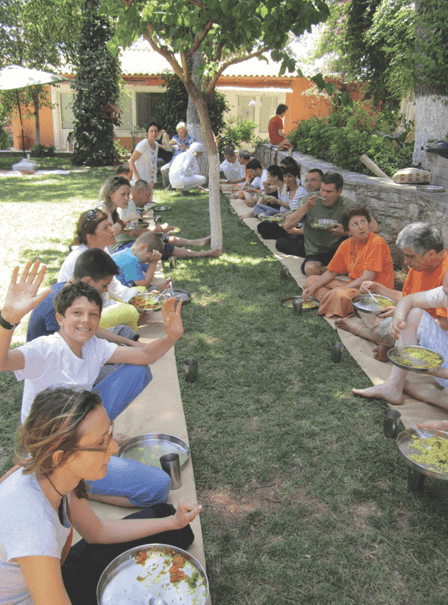
A yogic diet is based on the principles of Sattva (purity), aiming to promote clarity, peace, and vitality. The diet at the ashram comprises simple, regular vegetarian meals which are pure, fresh, light and balanced. Many of the ingredients are provided by the communal organic gardens. As much as possible, seasonal, local, whole nutritious foods are served. Vegetables, fruits, whole grains, nuts and seeds make up the diet. Occasionally, there is milk and cheese in some meals. Herbs and spices are used as they are essential in yogic cooking for example, turmeric, ginger, basil, salt and pepper. All food is considered as prasad (a blessed gift), therefore we give thanks to the food provided, take only what we need to minimise waste, and eat in a calm and clean environment.
How can you better understand the yogic philosophy?
If you are a beginner to yoga and want to expand your understanding of yogic philosophy, you can watch videos and read books at home or join a yoga class. Another way is to visit an ashram. Here, you will be living the philosophy as well as imbibing it through special programs, Satsangs and classes.
Satyanandashram Hellas welcomes visitors to come and stay for some days and take part in the Yogic Lifestyle Experience or the Ashram life program.
The Yogic Lifestyle Experience gives yoga teachers and their students the unique opportunity to live Yoga 24/7 in an ashram environment. It provides the tools for how one can apply the techniques of the Satyananda System of Yoga to one’s daily life keeping the body and mind healthy, restoring balance and ensuring a positive, optimistic, creative and spiritual way of living, which once learnt in the ashram, can be practiced at home.
The program includes practical classes, lectures and discussions, mantra chanting, pooja and havan.
The Yogic Lifestyle courses have been running for over fifteen years, based on the purpose that yoga should move out of the classrooms and become a daily living experience and a lifestyle that develops and transforms one’s personality and awakens one's innate human potential.
Visit our webpage:https//satyanandayoga.carrottechlab.net/en/events/yogic-lifestyle-experience/
Ashram life
This program offers the individual visitor the opportunity to experience ashram life first-hand. The emphasis of Ashram Life is on service (seva yoga). Through the practice of seva yoga we discover the deep facets of our personality and learn how to deal with ourselves, whilst simultaneously being active and efficient in life. In the ashram, one learns to live yoga from moment to moment and yoga a lifestyle. Days in the ashram vary according to the season. A typical day in the ashram may include the following: morning yoga class, karma yoga, meditation, yoga nidra of the Satyananda System of Yoga, evening programs, Saturday Mahamritunjaya mantra chanting with havan (fire ceremony), Shatkarmas (cleansing techniques of Hatha Yoga) and Guru Bhakti- the Yoga of Remembrance on the 4th-6th of every month. Visit our webpage: https//satyanandayoga.carrottechlab.net/en/events/ashram-life/