



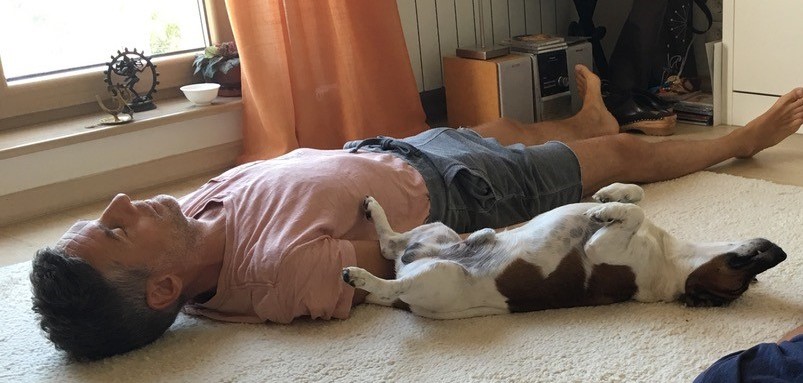

Looking for yoga relaxation techniques? Discover yoga for sleep and relaxation at home, calm your mind, and create peaceful evenings. Try it today!
The pace and demands of our modern lifestyle have tremendously pushed up our stress levels and decreased our time and ability to depressurize. Yoga has become increasingly popular as an effective way to relax, because it has specific techniques that can be applied in almost all situations by virtually everyone.
Why practice yoga for sleep and relaxation at home?
Throughout the day we accumulate tensions on different levels of our personality. As Sri Swami Satyananda has expertly described in his book Yoga Nidra, there are three different types of tension:
1. muscular tensions: these are related to the body, nervous system and endocrine imbalances.
2. emotional tensions: which stem from various dualities such as love/hate, success/failure, happiness/unhappiness, and so on.
3. mental tensions: these are the result of excessive mental activity and analysis.
Sometimes a fourth type of tension is also mentioned:
4. spiritual tensions: these are related to deep discontent, inner restlessness and a sense of lack of meaning or purpose, even though one may appear to have all they could desire at a material and social level.
In light of the above, relaxation is not a simple matter of slumping onto the couch with a glass of wine at the end of a hard day, or sleeping the tension and worries away.
A period of conscious relaxation is necessary at some point during the day, perhaps even before falling asleep, otherwise our dreaming and sleep states are filled with anxieties, and attempts to process and resolve our conscious issues fail. Stress and poor quality sleep are major factors in compromising our immune system and disrupting our mental state, performance, behaviour and reactions.
Yoga relaxation techniques that calm your mind and body
Throughout our life, experiences are registered and processed by our consciousness and accumulated in the different layers of our personality. Over time, the mental and emotional tensions are pushed down into deeper layers of the mind where they are less obvious and accessible. Can you imagine how your hair would look like if you never brushed it? In a similar manner can we imagine the state of our mind if it has never been unknotted, tidied or cleaned since the day we were born? This build- up of confusion and charge in the mind and body must be cleared and released on a regular basis.
Yoga has exceptional tools and techniques specifically for this purpose.
Observing the natural breath and deep breathing for instant calm
The easiest and most accessible way to relax is to start following one’s own natural breath. Start to notice where the breath can be felt in the physical body and then chose one area, for example the nostrils or the chest or the abdominal area, and observe each inhalation and each exhalation that happens there.
If it is comfortable and easy, start to encourage the breathing to become slower and deeper. This is not imposing or forcing the breath to change, but simply allowing it to become longer and deeper. By increasing the duration of the inhalation and especially the exhalation, we directly influence the autonomic nervous system in a calming way. By lengthening the exhalation, we increase the activation of the parasympathetic nervous system, which is essentially responsible for inducing rest, restoration and recuperation of the whole organism.
Breathing also directly effects our mental state inducing a calm, pleasant state, because it is anchoring our attention in the present.
Restorative yoga poses for sleep and relaxation
Daily demands on our physical body are often unnatural. There may be too little movement generally, excess repetitive movements of certain parts, holding positions too long like standing or sitting, or too strenuous activity.
Yoga poses greatly help release muscular tensions and skeletal loads and help the whole body to experience balance and ease.
In addition, the asanas provide a gentle stretching routine that open up the energy flows and restore energy distribution to previously blocked areas.
Guided meditation for mind relaxation and training
When the body and breath are sufficiently trained to allow us to introvert for a short while, then there are numerous meditation practices to try, which release superficial mental tensions from the day, and also dive into the mind to remove deeper tensions in the form of impressions, fears, complexes, worries and memories.
Guided meditations are very helpful in temporarily moving the attention away from the usual preoccupations and obsessions of our mind, and training it to follow the instructions, which are holding us in the present. This mind training is essentially increasing our awareness capacity, which over time de-stresses our whole outlook on life.
Yoga Nidra for deep rest and inner balance
Yoga Nidra is a specific technique compiled by Sri Swami Satyananda Saraswati from other ancient yogic and tantric practices. It can be practiced at home, or in a quiet closed room, at a comfortable temperature. Ideally, it should be practiced every day at the same time to form a positive habit, for example before lunch or when one returns home from work or in the evening before going to bed to induce a deep and refreshing sleep.
Through the systematic practice of Yoga Nidra, the threefold tensions are progressively released. This is important because, although sleep can reduce physical tension, it is not possible to relax emotional and mental tensions through ordinary sleep and relaxation alone. It goes without saying that Yoga Nidra is one of the great gifts to modern day man.
Tips for turning your yoga relaxation techniques into a daily ritual
Surely all the above sounds like exactly what we need, but how to incorporate it into our daily lives in a simple and meaningful way? Yoga always works best in smaller more regular doses, rather than larger random ones.
Pick one of the above practices that you feel suits your temperament and lifestyle most, and make a conscious decision to apply it for 5 minutes every day. Only 5 minutes, at a certain time, each day. For example, observing your natural breath after finishing your dinner, or doing 3-4 yoga stretches for your spine when you get out of bed in the morning, or consciously imagining all your tensions melt away from all the parts of your body each night before you wait for sleep to come. Once you have managed that one relaxation practice for 21 days in a row, then either increase the duration or add a second simple technique.
Remember to keep it all simple so that the relaxation practice itself does not become a stressful factor in your life. Within a very short period of time, you will start reaping the benefits of this very popular and deeply effective relaxation techniques.