






Wondering what the benefits of yoga are? Learn the top ten ways that yoga improves your mental and physical well-being. Read more in our article!
1.Better flexibility
No matter what age you are, what your profession is, or your physical condition at the moment, regular practice of gentle yoga asanas (physical postures) will gradually improve your flexibility over time. In the Satyananda System of Yoga, (SSY), the practitioner begins with the Pawanmuktasana series parts 1, 2 and 3 systematically building the foundation for more advanced asanas. This series has a profound effect not only on the physical body but also the mind which allows you to maintain all round good health.
2.Enhanced mood
Apart from the yoga asanas which softly and slowly stretch the body, these postures stimulate the release of several key hormones and neurotransmitters that promote relaxation, well-being, and balance. Combined with conscious breathing and certain pranayama practices1, the body releases serotonin, a hormone that regulates mood and promotes a sense of calm and happiness. Endorphins, which are natural painkillers and mood elevators, are also released during yoga practice and help create a feeling of euphoria as well as reducing pain or discomfort, especially during stretching or mild physical effort. Dopamine, associated with pleasure, motivation, and reward is another neurotransmitter secreted in the brain during a yoga session which improves focus and creates a positive mood.
3.Reduces stress
The typical yoga lesson of the Satyananda tradition encourages slow, conscious movement synchronized with the breath, which contribute to reduced anxiety and a sense of peace . You will feel a sense of calm after a yoga lesson that combines yoga asanas, breath awareness and pranayama, as well as relaxation practices such as long shavasana or a yoga nap (hallmarks of the Satyananda System of Yoga). For a longer and more effective relaxation practice an entire Satyananda Yoga Nidra session will induce deep relaxation on the muscular, mental, and emotional levels. Just 30-40 minutes of yoga nidra is equal to three hours of restorative sleep.
4.Better focus
There is a myriad of yoga practices that can and will improve your attention and focus, even if you are the most scatter-brain person you know. Various meditation practices and tratak (candle flame gazing or focusing on a certain symbol) will train your mind to be less dissipated, enhance memory and clarity.
Throughout a typical yoga lesson of the Satyananda tradition, you are continuously invited to focus on the "here and now" and to notice how often the mind wanders off. This training is carried with you out into your daily life, and within a few sessions you notice better focus and concentration in your everyday activities.
5.Builds strength
Through the physical poses done systematically and gradually, you will see an increase in your strength, a rise in your energy levels and experience greater vitality as well as strength of mind, as these two dimensions (the physical body and the mental body) are closely interrelated. Holding the yoga poses for several breaths builds muscular endurance and strength. Balancing poses improve bone density, strengthen ankles, knees, hips, shoulders, and the core. The sun and moon salutation sequences are a wonderful way to build endurance and resilience and you can adjust the number of rounds you do, depending on your daily schedule.
6.Improves the posture
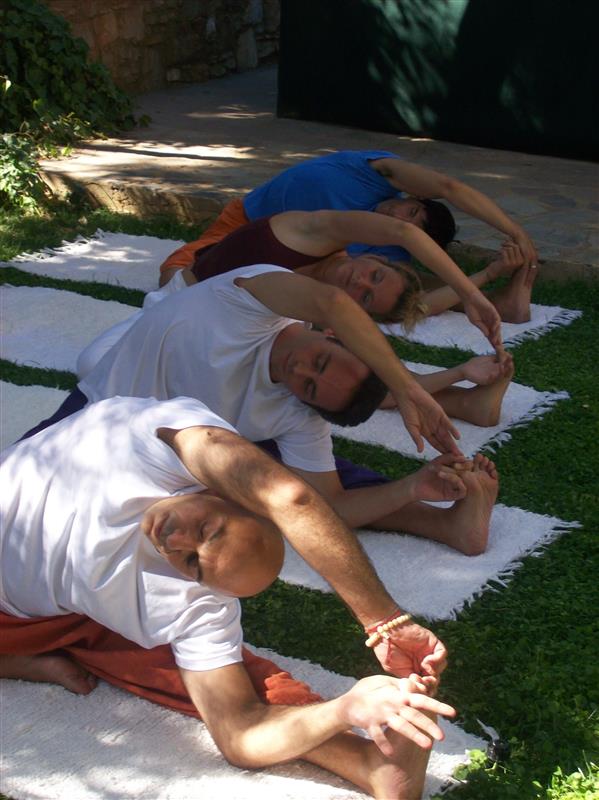
After about a month of yoga practice, you will observe a significant change in your body's posture and the benefits that follow, such as less pain in the neck and shoulders, knees and lower back, better breathing and digestion just to name a few. The SSY emphasizes the 7 basic movements of the spine (tadasana, tiryaka tadasana (or any sideways spine bending), katichakrasana (or any spinal twist), forward and backward bends) which strengthen the back, shoulders and leg muscles, and are particularly useful for those who spend a lot of time sitting down or who have stiffness or pain in the back.
7.Improves sleep quality
Yoga helps promote better sleep through a combination of physical relaxation, mental rest and tranquility, and nervous system regulation by activating the parasympathetic (rest-and-digest) response. Breathing practices such as nadi shodhana (alternate nostril breathing), bhramari or ujjayi pranayama, and slow rhythmic breathing as well as Satyananda Yoga Nidra reduce cortisol (stress hormone) levels and promote melatonin production which aids sleep onset and quality. Asanas that you can do just before sleeping to induce a relaxed state of body and mind can include marjariasana (cat stretch pose), shashankasana (moon pose) and naukasana (boat pose).
Over-analysing and overstimulation will definitely disrupt your sleep. In the SSY, one of the most popular practices is the Review of the Day. As you lie in shavasana (flat on your back), mentally move through the events of the day with the attitude of a spectator just like you would do while watching a film. Recall situations and interactions with others, observing and accepting any stressful or negative events and then thinking of ways to deal with them in a positive way for both you and the other people involved, if you were to come across this event again. Then set a positive intention for the following day. This is a type of mental journaling, that encourages mindfulness and non-reactivity and breaks the cycle of overthinking or rumination at bedtime.
8.Boosts self-awareness
"Awareness is the Alpha and Omega of Yoga" is a quote by Sri Swami Satyananda Saraswati which is emphasized in all the yoga lessons of the Satyananda Yoga tradition all around the world. When practicing yoga, you are instructed to become aware of your physical body, your breathing and at a later date awareness of your thoughts and emotions that arise. The benefits you reap is that you begin to get to know yourself on a deeper level. You become aware of your thought patterns, reactions, behaviours and attitudes observing yourself as an impartial witness that does not criticize nor judge but whose purpose is to familiarize yourself with who you actually are; and embrace your authenticity and uniqueness.
The countless meditation practices available lead to expanded awareness of the Self. You quickly come to realize the fact that you are not just the body, nor the senses, nor the mind, but something much, much, more than that, and this is when inner transformation takes place, as you discover your inner potential and allow it to blossom. Swami Niranjananada continuously encourages us to "become the beautiful you."
9.Helps heart health
Certain asanas, especially back bending ones, improve circulation, strengthen the heart, and help manage blood pressure. As a result, oxytocin, known as the “love” hormone is stimulated and released which promotes trust, emotional connection, and stress relief.
Some heart opening asanas include:
- Eka pada pranam asana (one legged prayer pose)
- Dwikonasana (double angle pose)
- Gomukasana (cow's face pose)
- Kandharasana (shoulder pose)
- Matsyasana (fish pose)
- Bhujangasana (cobra pose)
- Uthanpristhasana (lizard pose)
Awareness of the breath, rhythmic breathing, full yogic breath along with pranayama reduce stress hormones, lower blood pressure, and improve oxygenation. Some of the best techniques for heart health involve:
- Nadi Shodhana (alternate nostril breathing): balances the nervous system, reduces anxiety
- Bhramari (Humming bee breath): calms the mind and reduces blood pressure
- Sheetali Pranayama (Cooling breath): cools the body and relaxes the mind
- Ujjayi (Psychic breathing): enhances focus and slows the heart rate. Please note that if you have very low blood pressure this practice is to be avoided.
Regular meditation can lower resting heart rate, blood pressure and stress levels. Popular practices focus on present-moment awareness, expressing gratitude, forgiveness and loving-kindness visualisations that can be incorporated into a Satyananda Yoga Nidra session as well.
10.Improves digestion
The Pawanmuktasana series Part 2 is concerned specifically with strengthening the digestive system. It is excellent if you suffer from indigestion, constipation, acidity, excess wind, and lack of appetite.
There are other asanas and practices you can also add. Generally, the best times to practice for digestion are:
- Before meals: Gentle poses like twists and forward bends
- After meals: Only Vajrasana (thunderbolt pose) for 5–10 minutes. If there is pain in the ankles, knees or thighs, props can be used such as sitting on a rolled blanket or a yoga block.
- Morning: Energizing breathwork (like Kapalabhati) and dynamic poses (halasana (plough pose), druta halasana (dynamic plough pose), ushtrasana (camel pose), yogamudrasana (attitude of psychic union), matsyasana (fish pose)) and surya namaskara (salutation to the sun sequence)
- Evening: Relaxing twists and forward bends to wind down
How can you experience all the benefits of yoga first-hand?
To gain the full benefits of yoga, it is a good idea to join a yoga class and be properly trained by a certified yoga instructor. There are also a great many books you can use for reference and additional information as well as videos. If you are lucky enough to visit an ashram, or participate in Satsang with a yoga master, this will greatly accelerate your yoga experience.
See yoga as a special time for looking after yourself, for self-exploration and self-development. Once you start, and feel the vital force awakening within you, feel the happiness bubbling up from inside and the harmony emanating from you, you will never want to stop!
Visit our You Tube channel for free yoga sessions: https://www.youtube.com/c/SatyanandashramHellas/playlists