




Updated on: 12.02.2025

“To transcend the body does not mean to just forget about it. One has to purify it. Therefore, these six kriyas of hatha yoga are necessary for spiritual aspirants.”1 

Swami Satyananda Saraswati 

Shatkarma: Meaning 

Shatkarmas, sometimes referred to as shatkriyas, are six groups of cleansing techniques within the hatha yoga tradition whose purpose is to purify the body and mind by creating harmony between the two major pranic flows, ida and pingala and as a result prepare the practitioner for higher practices, and in particular pranayama.  

Most people who practice hatha yoga may not have heard of them, or if they have, rarely practice them and yet these techniques have a direct effect on one’s health. They have been used over millennia by yogis for preventative purposes because they balance the three doshas (humours) in the body. According to Ayurveda (traditional Indian medicine), when there is an imbalance in the doshas (kapha ;mucus, pitta; bile  and vata; wind), illness will manifest.  

Why is shatkarma essential in yoga practice?

Shatkarmas are essential in yoga practice because they serve as a preparatory system for both physical and mental purification, ensuring that the practitioner is ready for higher yogic practices. The six cleansing techniques—Neti, Dhauti, Basti, Nauli, Kapalbhati, and Trataka—remove toxins from the body, balance the three doshas (vata, pitta, kapha), and clear the nadis (energy channels), allowing the free flow of prana (vital energy). According to classical yogic texts like the Hatha Yoga Pradipika, an impure body can hinder the effectiveness of pranayama and meditation. Without proper cleansing, blockages in the body can cause physical discomfort, mental restlessness, and energetic imbalances making it difficult for a practitioner to progress on the spiritual path.

Furthermore, under the direct guidance of Sri Swami Satyananda, Swami Muktibodhananda wrote a commentary on the Hatha Yoga Pradipika and emphasized the significance of shatkarmas in harmonizing the body’s internal systems and preparing the mind for deep concentration.

Shatkarmas not only detoxifies the body but also fosters emotional stability and mental discipline, ultimately leading to greater awareness and inner transformation. This purification process is fundamental in Hatha Yoga, as it lays the foundation for deeper sadhanas, allowing practitioners to experience higher states of consciousness with greater ease and stability.

Why do toxins stop yogic and spiritual progress?

Toxins hinder yogic progress by disrupting the body’s balance, blocking the flow of prana and clouding the mind, making higher states of awareness difficult to attain. According to the teachings of Sri Swami Satyananda and Swami Niranjanananda, an impure body accumulates excess mucus, acidity, and waste, which can lead to lethargy, disease, and mental disturbances, preventing the practitioner from maintaining deep concentration and steady meditation. Without internal purification through shatkarmas, these toxins create obstacles in both the physical and subtle energy systems, limiting one’s ability to experience the transformative effects of yoga.

Additionally, the ancient yogic texts emphasize that spiritual evolution requires a purified vessel, as a body burdened with toxins cannot effectively sustain advanced practices such as pranayama, mantra chanting, and prolonged meditation. The buildup of impurities also affects the nervous system, leading to restlessness and distraction, which interfere with the practitioner’s ability to cultivate inner stillness.

By practicing shatkarmas, yogis clear the nadis and prepare the body to handle higher energy states, ultimately enabling a smoother and more effective spiritual journey.

Are shatkarmas suitable for beginners?

Shatkarmas, while highly beneficial, may not be suitable for complete beginners without proper guidance. These six purification techniques—Neti, Dhauti, Basti, Nauli, Kapalbhati, and Trataka—require precise instruction to avoid potential imbalances or adverse effects. According to the classical texts and modern commentaries, such as Hatha Yoga Pradipika these practices are best learned under the supervision of an experienced teacher to ensure they are performed safely and appropriately for the individual’s constitution and needs.

That being said, some milder forms of shatkarmas, such as neti or mild kapalbhati, can be integrated into a beginner’s routine when taught correctly. In the ashram, the three purification practices of neti, kunjal, and laghoo are available twice per week upon request, with instructions provided by a qualified teacher. The more advanced cleansing techniques, like nauli or dhauti, should only be attempted after foundational yoga training, as they involve intricate internal manipulations that demand control and experience.

The shatkarmas of neti, kunjal, and laghoo play a crucial role in preparing the body for more advanced yoga practices such as Kriya Yoga, as they cleanse the internal systems, remove toxins, and ensure the free flow of prana, creating the necessary physical and mental clarity for deeper yogic practices.

Where to practice?

Each of the six shatkarmas have a variety of practices and stages. They are very powerful techniques and must only be learnt at an ashram and taught by a guru or by specialized yoga instructors as there are serious contra-indications which need to be taken into account as well as the fact that each individual will have their own limitations. So, these practices can not be learnt from a book or a video as there must be supervision at each stage.   

What are the 6 types of Shatkarma Yoga? Benefits And Contra-Indicators 

Neti 

Neti is a process of cleansing and purifying the nasal passages. There is jala neti (nasal cleansing with water) which is a very popular method and recommended now by ENT (ear-nose-throat) surgeons while sutra neti (nasal cleansing with thread) should be done with greater caution.  

Contra-indications: Those who suffer from chronic bleeding in the nose need to first seek medical advice before doing any of the practices. Those who are prone to or have ear infections should not do neti. During colds, flu or sinusitis when the nose is totally blocked ought to avoid neti.  If one has nasal ulcers, polyps, or severe malformation of the nasal septum or turbinates, they should seek advice from their medical practitioner before doing sutra neti.  

Benefits: It removes mucus and pollution from the nasal passages and sinuses, allowing air to flow without obstruction. It helps prevent and manage respiratory tract diseases. It helps to maintain good health of the ears, eyes and throat and relieves muscular tension of the face bringing about a fresh and youthful appearance. It has a calming and soothing influence on the brain as well as alleviating anxiety, anger and depression. It removes drowsiness and makes the head feel light and fresh.  

Dhauti 

Dhauti is a series of cleansing techniques that are further divided into 

 (i) antar dhauti :internal cleansing 

(ii) sirsha dhauti : head cleansing 

(iii) hrid dhauti: thoracic cleansing 

In Sri Swami Satyananda’s comprehensive book Asana, Pranayama, Mudra, Bandha four practices of the dhauti shatkarma group are specified. 

  1. a) Shankaprakshalana (varisara dhauti) is the cleansing of the entire digestive tract. 

This practice must only be done at the ashram and needs preparation before commencement and a special diet after completion. Satyanandashram Hellas conducts this practice twice a year in the spring and autumn, and there are very strict pre-requisites that one must fulfil as well as the need to stay at the ashram for a few days upon completion of the practice. Under no circumstances should you do this practice on your own.  

Contra-indications: People with heart or kidney problems or high blood pressure should not practice shankaprakshalana or laghoo. Those suffering any illness, doing therapy or taking medication ought to consult their doctor before attempting the practice. The practice should be avoided during pregnancy.  

Benefits: Shankaprakshalana alleviates digestive problems, tones the liver and other digestive organs and glands. It strengthens the immune system, reduces excessive mucus and purifies the blood. It recharges the entire pranic body removing blockages from the nadis, and purifies all the chakras. The harmony of the five pranas is restored and the energy level is raised. 

laghoo shankaprakshalana (short intestinal wash) The short intestinal wash can be done at home, once it is learnt well. 

Contra-indications: the same as Shankaprakshalana (varisara dhauti) 

Benefits: It enables normal functioning of the intestines and can be practiced regularly. It is recommended for digestive disorders and flushes out the kidneys. Greater benefits will be experienced when you combine this practice with light meals.  

  1. b) Agnisar kriya (vahnisara dhauti) is where the digestive fire is activated

Contra-indications: Those suffering from high blood pressure, heart disease, acute duodenal or peptic ulcers, an over-active thyroid gland or chronic diarrhoea should not perform this kriya. Also, pregnant women ought to refrain from this practice.  

Benefits: It stimulates the appetite and improves digestion. It massages the abdomen, strengthens the abdominal muscles and encourages optimum health of the abdominal organs. It also alleviates depression, dullness and lethargy.  

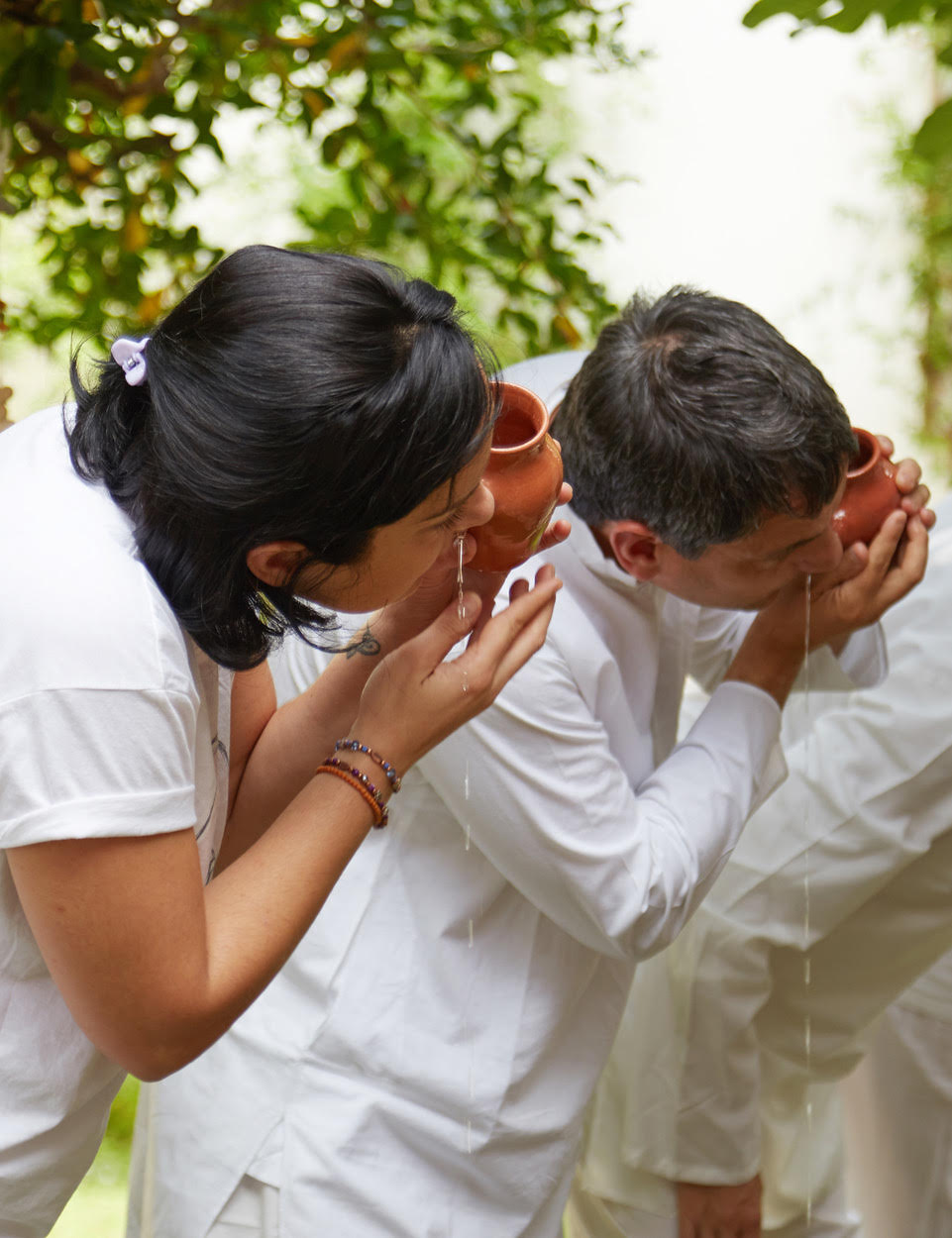
  1. c) Kunjal (vaman dhauti) cleanses the stomach by regurgitating water

Contra-indications: Those suffering from hernia, high blood pressure, raised intracranial pressure, heart disease, stroke, acute peptic ulcer, or eye problems caused by diabetes should not do this practice. If pregnant, also refrain from this technique.  

Benefits: Apart from stimulating the abdominal organs by the strong muscular contractions in the stomach wall when regurgitating the water, excess mucus is removed helping respiratory functions. It is a very effective practice to release pent-up emotions and emotional blocks or feelings of heaviness in the heart caused by inner and external conflicts and pressure.  

  1. d) Vatsara dhauti cleanses the intestines with air by sucking in the air through the mouth and filling the stomach with air. The air is then expelled through the large intestine. 

Benefits: It removes stale gas and wind stimulating the digestive system.  

Nauli 

Nauli is a method of rolling the abdominal muscles and thus massaging and strengthening the abdominal organs which has various stages and requires awareness and control of the many muscles in the abdomen. One needs to master agnisara kriya and uddiyana bandha before performing nauli practices.  

Contra-indications: Nauli must not be done by people suffering from heart disease, hypertension, hernia, high blood pressure, abdominal pain, gall stones, acute peptic ulcer, constipation or those who are recovering from surgery, especially abdominal. Pregnant women should not practice nauli. However, 6 months after natural birth it can strengthen the abdominal and pelvic muscles.   

Benefits: The practices massage and tone the whole abdominal region including the muscles, nerves, intestines, reproductive, urinary and excretory organs. It balances the endocrine system by working on the adrenal glands. It purifies manipura chakra which is the storehouse of prana.  

Basti  

Basti are techniques for washing and toning the large intestines and are known as the yogic enema. Jala basti requires the practitioner to stand in pure water up to the navel, ideally a river. The practitioner draws the water in through the anus by controlling the anal sphincter and continues to draw water into the bowels where it is held for some time and then expelled.  

A simpler version is sitting in cool, fresh water up to the navel and performing ashwini mudra.  

Sthala basti is a dry yogic enema while moola shodhana is an anal cleansing method.  

Benefits: In each of these techniques, the colon and anal region is cleaned and purified.  

Kapalbhati 

This is a breathing technique for purifying the frontal region of the brain. There are three different techniques: vatkrama Kapalbhati (air cleansing), vyutkrama Kapalbhati (sinus cleansing), and  sheetkrama Kapalbhati (mucus cleansing) 

Contra-indications: People who experience frequent nasal bleeding should avoid these practices.  Those suffering from heart disease, high blood pressure, vertigo, epilepsy, stroke, hernia or gastric ulcer should not practice Kapalbhati. Also, it is not recommended during pregnancy.  

Benefits: It has a cleansing effect on the lungs and is a good practice for respiratory disorders. It balances and strengthens the nervous system as well as toning the digestive organs. It energises the mind for mental work and removes sleepiness.  

Trataka 

The practice of intense gazing at one point or an object. There are two stages of tratak: bahiranga (external gazing) and antaranga (internal gazing).

Contra-indications: In the case of epilepsy or eye ailments such as eyestrain, astigmatism, early symptoms of cataract, one should not practice on a flame but can fix their gaze on a black doton a white sheet of paper. Those with myopia (short-sightedness) who need to wear glasses should do so when gazing at the flame. Those who suffer glaucoma should not practice tratak.  


Benefits: Gazing at a steady candle flame makes the eyes clear and bright. It balances the nervous system, improves memory, develops good concentration and strong willpower. It activates ajna chakra and prepares the practitioner for meditation.  

Do-it-yourself health care 

The Satyananda System of Yoga places special emphasis on the shatkarmas which are part of the yoga classes and a regular practice at the ashram 

Jala neti (cleansing the nostrils), laghoo (short intestinal wash) and kunjal (stomach cleansing) are easy to learn and once mastered can safely be practiced at home. Tratak and kapalbhati can also be part of one’s home practice.  

Another very effective method to overcome constipation, a condition that many people today suffer from, is the TTK (tadasana, tiryakatadasana, katichakrasana) solution devised by Sri Swami Satyananda. All it takes is one litre of warm salted water or pure unsalted water at room temperature. Drink one glass of water fairly quickly, in other words do not sip it but drink it down and then perform the three following asanas 10 times each. First tadasana ten rounds, then tiryaka tadasana ten rounds, and end with katichakrasana ten rounds. Drink another glass of water and repeat this sequence. You do this by drinking four glasses of water. Then go to the toilet but do not strain or force bowel movement. Give it time.  

The TTK solution needs to be done upon awakening on an empty stomach. You can practice it daily until constipation is removed. Also, you can do it once a week to maintain general health.  

Why is it important to regularly do shatkarma? 

The shatkarmas play a major role in improving the quality of one’s life and give people a way of becoming more independent and pro-active in their personal health care by maintaining and enhancing the functioning of the body’s systems including the brain.  

If you would like to learn more about the shatkarmas or do the twice a year shankaprakshalana practice and enjoy the benefits, please contact us at: info@satyanandayoga.gr 

satyananda yoga logo

Satyanandashram Hellas

Alithias 1, 19002 Paiania, Greece

PO Box 22, 19002 Paiania, Greece

+306947009660

info@satyanandayoga.gr

Paiania Meditation Center

Dimarchou Iona Vore (former Diadochou Konstantinou) 32, 19002 Paiania

+30 210 6641545, 695 6482415

sycp@satyanandayoga.gr

Athens Meditation Center

Simetelou 2, 115 28, Athens

210 3311178, 694 2974467

syca@satyanandayoga.gr

Thessaloniki Meditation Center

Proxenou Koromila 1, 54623 Thessaloniki

+30 2310 283109

sycs@satyanandayoga.gr

The trademark Satyanandashram Hellas CENTER OF YOGA® is a trademark owned by Satyanandashram Hellas, Greece and used with permission.
The term SATYANANDA YOGA® is a trademark owned by IYFM and used with permission.
Satyananda Yoga Nidra® is a registered trademark of IYFM used with permission.

How you can be part of this beautiful community of service

You are welcome to come and unite in our efforts to help us accomplish our aims and goals. Our association needs people who are ready to offer their hearts, their skills and ideas as well as monetary contributions, and to integrate their ‘head, heart and hands’ in service.

If you consider the needs of others, we need you.
If you have a generous heart, we need you.
Ιf you have large hands, we need you.
If you have bright ideas, we need you.

Your contributions allow us to reach out to more and more people. Your contributions enable us to support and work towards the fulfilment of the vision of Swami Satyananda, Swami Niranjanananda and their lineage  that of peace and prosperity for all humankind.

X

What are the 6 Types of Shatkarma Cleansing Techniques?

Updated on: 12.02.2025

"To transcend the body does not mean to just forget about it. One has to purify it. Therefore, these six kriyas of hatha yoga are necessary for spiritual aspirants."1 

Swami Satyananda Saraswati 

Shatkarma: Meaning 

Shatkarmas, sometimes referred to as shatkriyas, are six groups of cleansing techniques within the hatha yoga tradition whose purpose is to purify the body and mind by creating harmony between the two major pranic flows, ida and pingala and as a result prepare the practitioner for higher practices, and in particular pranayama.  

Most people who practice hatha yoga may not have heard of them, or if they have, rarely practice them and yet these techniques have a direct effect on one's health. They have been used over millennia by yogis for preventative purposes because they balance the three doshas (humours) in the body. According to Ayurveda (traditional Indian medicine), when there is an imbalance in the doshas (kapha ;mucus, pitta; bile  and vata; wind), illness will manifest.  

Why is shatkarma essential in yoga practice?

Shatkarmas are essential in yoga practice because they serve as a preparatory system for both physical and mental purification, ensuring that the practitioner is ready for higher yogic practices. The six cleansing techniques—Neti, Dhauti, Basti, Nauli, Kapalbhati, and Trataka—remove toxins from the body, balance the three doshas (vata, pitta, kapha), and clear the nadis (energy channels), allowing the free flow of prana (vital energy). According to classical yogic texts like the Hatha Yoga Pradipika, an impure body can hinder the effectiveness of pranayama and meditation. Without proper cleansing, blockages in the body can cause physical discomfort, mental restlessness, and energetic imbalances making it difficult for a practitioner to progress on the spiritual path.

Furthermore, under the direct guidance of Sri Swami Satyananda, Swami Muktibodhananda wrote a commentary on the Hatha Yoga Pradipika and emphasized the significance of shatkarmas in harmonizing the body's internal systems and preparing the mind for deep concentration.

Shatkarmas not only detoxifies the body but also fosters emotional stability and mental discipline, ultimately leading to greater awareness and inner transformation. This purification process is fundamental in Hatha Yoga, as it lays the foundation for deeper sadhanas, allowing practitioners to experience higher states of consciousness with greater ease and stability.

Why do toxins stop yogic and spiritual progress?

Toxins hinder yogic progress by disrupting the body's balance, blocking the flow of prana and clouding the mind, making higher states of awareness difficult to attain. According to the teachings of Sri Swami Satyananda and Swami Niranjanananda, an impure body accumulates excess mucus, acidity, and waste, which can lead to lethargy, disease, and mental disturbances, preventing the practitioner from maintaining deep concentration and steady meditation. Without internal purification through shatkarmas, these toxins create obstacles in both the physical and subtle energy systems, limiting one's ability to experience the transformative effects of yoga.

Additionally, the ancient yogic texts emphasize that spiritual evolution requires a purified vessel, as a body burdened with toxins cannot effectively sustain advanced practices such as pranayama, mantra chanting, and prolonged meditation. The buildup of impurities also affects the nervous system, leading to restlessness and distraction, which interfere with the practitioner's ability to cultivate inner stillness.

By practicing shatkarmas, yogis clear the nadis and prepare the body to handle higher energy states, ultimately enabling a smoother and more effective spiritual journey.

Are shatkarmas suitable for beginners?

Shatkarmas, while highly beneficial, may not be suitable for complete beginners without proper guidance. These six purification techniques—Neti, Dhauti, Basti, Nauli, Kapalbhati, and Trataka—require precise instruction to avoid potential imbalances or adverse effects. According to the classical texts and modern commentaries, such as Hatha Yoga Pradipika these practices are best learned under the supervision of an experienced teacher to ensure they are performed safely and appropriately for the individual's constitution and needs.

That being said, some milder forms of shatkarmas, such as neti or mild kapalbhati, can be integrated into a beginner's routine when taught correctly. In the ashram, the three purification practices of neti, kunjal, and laghoo are available twice per week upon request, with instructions provided by a qualified teacher. The more advanced cleansing techniques, like nauli or dhauti, should only be attempted after foundational yoga training, as they involve intricate internal manipulations that demand control and experience.

The shatkarmas of neti, kunjal, and laghoo play a crucial role in preparing the body for more advanced yoga practices such as Kriya Yoga, as they cleanse the internal systems, remove toxins, and ensure the free flow of prana, creating the necessary physical and mental clarity for deeper yogic practices.

Where to practice?

Each of the six shatkarmas have a variety of practices and stages. They are very powerful techniques and must only be learnt at an ashram and taught by a guru or by specialized yoga instructors as there are serious contra-indications which need to be taken into account as well as the fact that each individual will have their own limitations. So, these practices can not be learnt from a book or a video as there must be supervision at each stage.   

What are the 6 types of Shatkarma Yoga? Benefits And Contra-Indicators 

Neti 

Neti is a process of cleansing and purifying the nasal passages. There is jala neti (nasal cleansing with water) which is a very popular method and recommended now by ENT (ear-nose-throat) surgeons while sutra neti (nasal cleansing with thread) should be done with greater caution.  

Contra-indications: Those who suffer from chronic bleeding in the nose need to first seek medical advice before doing any of the practices. Those who are prone to or have ear infections should not do neti. During colds, flu or sinusitis when the nose is totally blocked ought to avoid neti.  If one has nasal ulcers, polyps, or severe malformation of the nasal septum or turbinates, they should seek advice from their medical practitioner before doing sutra neti.  

Benefits: It removes mucus and pollution from the nasal passages and sinuses, allowing air to flow without obstruction. It helps prevent and manage respiratory tract diseases. It helps to maintain good health of the ears, eyes and throat and relieves muscular tension of the face bringing about a fresh and youthful appearance. It has a calming and soothing influence on the brain as well as alleviating anxiety, anger and depression. It removes drowsiness and makes the head feel light and fresh.  

Dhauti 

Dhauti is a series of cleansing techniques that are further divided into 

 (i) antar dhauti :internal cleansing 

(ii) sirsha dhauti : head cleansing 

(iii) hrid dhauti: thoracic cleansing 

In Sri Swami Satyananda's comprehensive book Asana, Pranayama, Mudra, Bandha four practices of the dhauti shatkarma group are specified. 

  1. a) Shankaprakshalana (varisara dhauti) is the cleansing of the entire digestive tract. 

This practice must only be done at the ashram and needs preparation before commencement and a special diet after completion. Satyanandashram Hellas conducts this practice twice a year in the spring and autumn, and there are very strict pre-requisites that one must fulfil as well as the need to stay at the ashram for a few days upon completion of the practice. Under no circumstances should you do this practice on your own.  

Contra-indications: People with heart or kidney problems or high blood pressure should not practice shankaprakshalana or laghoo. Those suffering any illness, doing therapy or taking medication ought to consult their doctor before attempting the practice. The practice should be avoided during pregnancy.  

Benefits: Shankaprakshalana alleviates digestive problems, tones the liver and other digestive organs and glands. It strengthens the immune system, reduces excessive mucus and purifies the blood. It recharges the entire pranic body removing blockages from the nadis, and purifies all the chakras. The harmony of the five pranas is restored and the energy level is raised. 

laghoo shankaprakshalana (short intestinal wash) The short intestinal wash can be done at home, once it is learnt well. 

Contra-indications: the same as Shankaprakshalana (varisara dhauti) 

Benefits: It enables normal functioning of the intestines and can be practiced regularly. It is recommended for digestive disorders and flushes out the kidneys. Greater benefits will be experienced when you combine this practice with light meals.  

  1. b) Agnisar kriya (vahnisara dhauti) is where the digestive fire is activated

Contra-indications: Those suffering from high blood pressure, heart disease, acute duodenal or peptic ulcers, an over-active thyroid gland or chronic diarrhoea should not perform this kriya. Also, pregnant women ought to refrain from this practice.  

Benefits: It stimulates the appetite and improves digestion. It massages the abdomen, strengthens the abdominal muscles and encourages optimum health of the abdominal organs. It also alleviates depression, dullness and lethargy.  

  1. c) Kunjal (vaman dhauti) cleanses the stomach by regurgitating water

Contra-indications: Those suffering from hernia, high blood pressure, raised intracranial pressure, heart disease, stroke, acute peptic ulcer, or eye problems caused by diabetes should not do this practice. If pregnant, also refrain from this technique.  

Benefits: Apart from stimulating the abdominal organs by the strong muscular contractions in the stomach wall when regurgitating the water, excess mucus is removed helping respiratory functions. It is a very effective practice to release pent-up emotions and emotional blocks or feelings of heaviness in the heart caused by inner and external conflicts and pressure.  

  1. d) Vatsara dhauti cleanses the intestines with air by sucking in the air through the mouth and filling the stomach with air. The air is then expelled through the large intestine. 

Benefits: It removes stale gas and wind stimulating the digestive system.  

Nauli 

Nauli is a method of rolling the abdominal muscles and thus massaging and strengthening the abdominal organs which has various stages and requires awareness and control of the many muscles in the abdomen. One needs to master agnisara kriya and uddiyana bandha before performing nauli practices.  

Contra-indications: Nauli must not be done by people suffering from heart disease, hypertension, hernia, high blood pressure, abdominal pain, gall stones, acute peptic ulcer, constipation or those who are recovering from surgery, especially abdominal. Pregnant women should not practice nauli. However, 6 months after natural birth it can strengthen the abdominal and pelvic muscles.   

Benefits: The practices massage and tone the whole abdominal region including the muscles, nerves, intestines, reproductive, urinary and excretory organs. It balances the endocrine system by working on the adrenal glands. It purifies manipura chakra which is the storehouse of prana.  

Basti  

Basti are techniques for washing and toning the large intestines and are known as the yogic enema. Jala basti requires the practitioner to stand in pure water up to the navel, ideally a river. The practitioner draws the water in through the anus by controlling the anal sphincter and continues to draw water into the bowels where it is held for some time and then expelled.  

A simpler version is sitting in cool, fresh water up to the navel and performing ashwini mudra.  

Sthala basti is a dry yogic enema while moola shodhana is an anal cleansing method.  

Benefits: In each of these techniques, the colon and anal region is cleaned and purified.  

Kapalbhati 

This is a breathing technique for purifying the frontal region of the brain. There are three different techniques: vatkrama Kapalbhati (air cleansing), vyutkrama Kapalbhati (sinus cleansing), and  sheetkrama Kapalbhati (mucus cleansing) 

Contra-indications: People who experience frequent nasal bleeding should avoid these practices.  Those suffering from heart disease, high blood pressure, vertigo, epilepsy, stroke, hernia or gastric ulcer should not practice Kapalbhati. Also, it is not recommended during pregnancy.  

Benefits: It has a cleansing effect on the lungs and is a good practice for respiratory disorders. It balances and strengthens the nervous system as well as toning the digestive organs. It energises the mind for mental work and removes sleepiness.  

Trataka 

The practice of intense gazing at one point or an object. There are two stages of tratak: bahiranga (external gazing) and antaranga (internal gazing).

Contra-indications: In the case of epilepsy or eye ailments such as eyestrain, astigmatism, early symptoms of cataract, one should not practice on a flame but can fix their gaze on a black doton a white sheet of paper. Those with myopia (short-sightedness) who need to wear glasses should do so when gazing at the flame. Those who suffer glaucoma should not practice tratak.  


Benefits: Gazing at a steady candle flame makes the eyes clear and bright. It balances the nervous system, improves memory, develops good concentration and strong willpower. It activates ajna chakra and prepares the practitioner for meditation.  

Do-it-yourself health care 

The Satyananda System of Yoga places special emphasis on the shatkarmas which are part of the yoga classes and a regular practice at the ashram 

Jala neti (cleansing the nostrils), laghoo (short intestinal wash) and kunjal (stomach cleansing) are easy to learn and once mastered can safely be practiced at home. Tratak and kapalbhati can also be part of one's home practice.  

Another very effective method to overcome constipation, a condition that many people today suffer from, is the TTK (tadasana, tiryakatadasana, katichakrasana) solution devised by Sri Swami Satyananda. All it takes is one litre of warm salted water or pure unsalted water at room temperature. Drink one glass of water fairly quickly, in other words do not sip it but drink it down and then perform the three following asanas 10 times each. First tadasana ten rounds, then tiryaka tadasana ten rounds, and end with katichakrasana ten rounds. Drink another glass of water and repeat this sequence. You do this by drinking four glasses of water. Then go to the toilet but do not strain or force bowel movement. Give it time.  

The TTK solution needs to be done upon awakening on an empty stomach. You can practice it daily until constipation is removed. Also, you can do it once a week to maintain general health.  

Why is it important to regularly do shatkarma? 

The shatkarmas play a major role in improving the quality of one's life and give people a way of becoming more independent and pro-active in their personal health care by maintaining and enhancing the functioning of the body's systems including the brain.  

If you would like to learn more about the shatkarmas or do the twice a year shankaprakshalana practice and enjoy the benefits, please contact us at: info@satyanandayoga.gr