



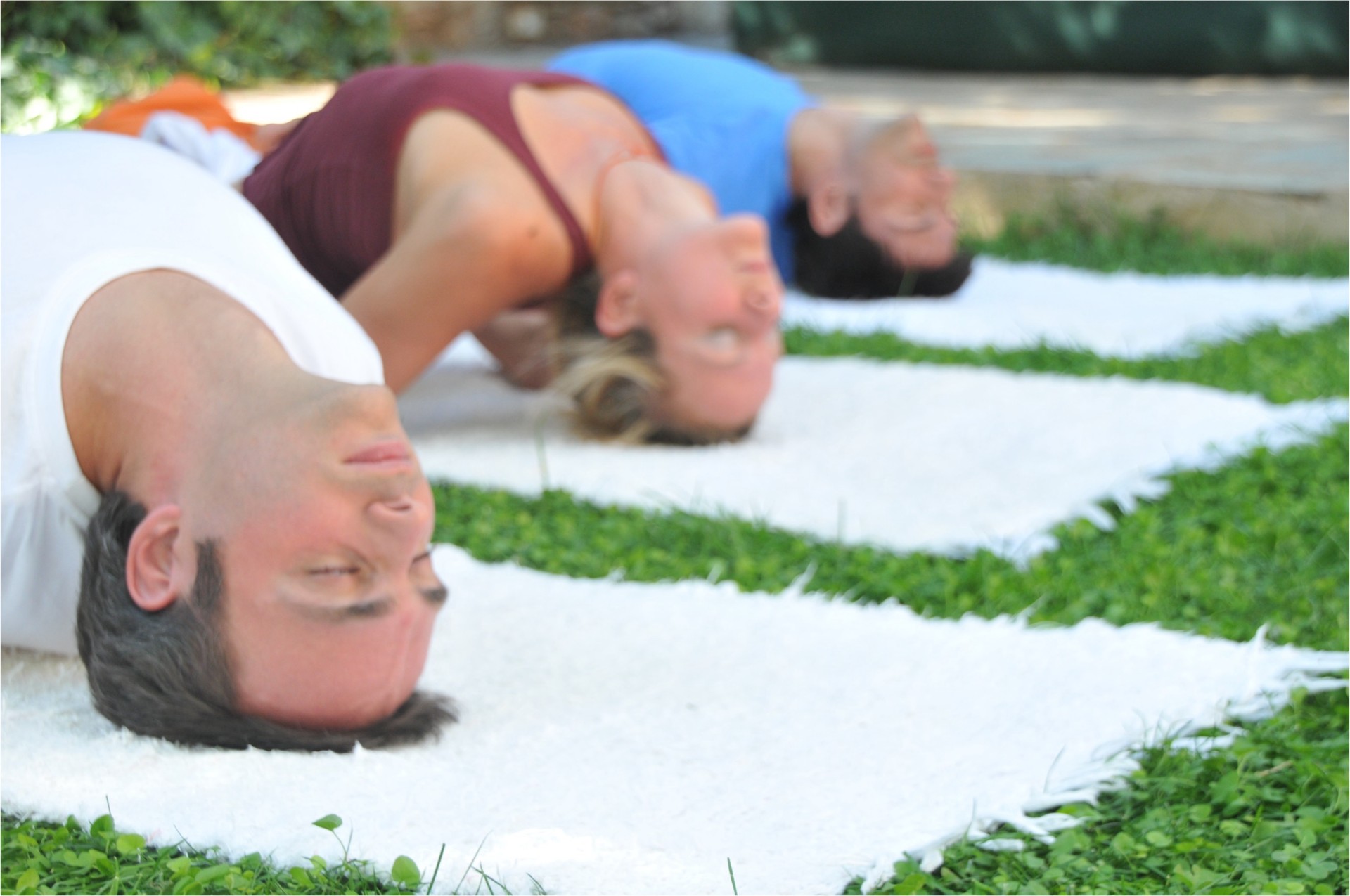

Most of us live in large urban centres in an apartment, spend prolonged periods of time in front of a screen and drive around in cars to get to places. Spending time outdoors and enjoying nature is rare in most people's lives today, but it is not impossible. Wherever you are in the world, you can find a natural beauty spot: a river, the sea, a lake, the ocean, a park, a forest, a mountain, a meadow, a beautiful garden, an ancient temple on a hill.
Spending time in nature is above all relaxing for the soul as we connect with mother earth. The ancient Greek philosopher Aristotle1 praised nature and taught that, "In all things of nature, there is something of the marvelous"
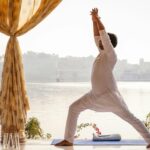
So, once you have found your natural beauty spot you can invite friends to join you or if you are a yoga teacher, organise a yoga class to do outdoors. There are countless practices to do and below are just a few:
-
Hastha utthanasana2 (hand raising pose)
This is an asana and simultaneously a pre-pranayama practice which exercises the intercoastal muscles of the ribs as well as massaging the lungs. You can stand, for example, facing the sea or a lake or at the top of a mountain. Stand with your feet together or slightly apart and arms by the sides. Relax the whole body balancing the body weight on both feet. Then cross the hands in front of the body, inhale deeply through the nose and slowly raise the arms above the head (keeping the hands crossed). Synchronize the movement with the breath. At the same time bend the head slightly backwards and look up at the hands. Exhale through the nose slowly and spread the arms out to the sides so that they form a straight line at shoulder level. Inhale and reverse the movement, re-crossing the arms above the head. Then exhale and lower the arms straight down the front of the body so that they are once again in the starting position. Repeat the process 10-15 times. Maintain awareness on the breath synchronised with the hand movement.
Benefits: rectifies round shoulders; removes stiffness from shoulders and upper back; improves breathing capacity; improves blood circulation and the whole body, especially the brain receives an extra supply of oxygen.
-
. Surya Namaskara
Surya Namaskara or salutation to the sun are twelve yoga postures which are put together as a sequence to generate prana (subtle energy) aiming towards the purification and rejuvenation of the practitioner. Preferably, the sequence can be performed early in the morning at sunrise or at sunset facing in the direction of the sun. Avoid this practice when temperatures are very high. During the winter it is ideal to do it outdoors under the sun. Sri Swami Sivananda Saraswati, who was a practicing medical doctor tells us that "the sun is the source of life and energy and has tremendous healing power. It is the best disinfectant in the world to kill germs and parasites. It tones the skin and nerves and fills the whole system with energy and power. It supplies vitamin D."3
To see the entire sequence from Bihar School of Yoga go to the link below and choose the class 2.4 class 4
https://www.biharyoga.net/yoga-for-everyone-training-bihar-yoga-satyananda-yoga-two.php
precaution: Surya Namaskara should not be performed by people who have high blood pressure, coronary artery disease, who have had a stroke, who are taking heavy medication or doing chemo therapy.
-
Walking barefoot
You can walk along any natural soft surface barefoot such as, a sandy sea shore, the bank of a river, in a park with soft grass or anywhere it is safe to walk barefoot. Make sure the surface is not hard and there are no sharp objects. As you walk on the earth, feel the connection of the souls of your feet with mother earth. Walk slowly and rhythmically chanting the mantra Om with every step either softly or to yourself.
Benefits: strengthens feet, improves balance, and improves sleep. Chanting Om calms the mind, reduces stress, creates deeper relaxation and greater focus.
-
Meditation on natural sound4
Sit or lie in a comfortable position. Relax your whole body and make sure there is no tension anywhere. Close your eyes and remain still. Let yourself dissolve and blend with the sounds produced by nature. Listen to the wind blowing through the trees. Become aware of the subtle differences created by wind forces, the different sounds emanating from the various types of trees. They are like the scales of a flute. Seek out the mellow and softer sounds and centre your concentration on them.
Now listen for any bird sounds. Allow the sound of the wind to fade into the background and bring the sounds of the birds to prominence. Listen to the melodious singing, chirping calls and constant chatter of the birds. Take your awareness from one bird sound to another, from the most distant sound to those coming from somewhere close by.
Listen now to the general environmental sounds. Shift your awareness from sound to sound. Do not become involved in any one sound. Move from high sounds to low sounds, soft to loud, distant to close. Do not judge or classify the sounds, merely witness and flow with the vibrations created by nature herself.
Bring your awareness back to the wind . Feel its force on your skin, caressing your face, blowing though your hair. Feel the ebbing in its force, becoming stronger, becoming gentle. Allow your whole body to experience the sensations, to become part of them, to become the wind itself blowing boundlessly and happily through the swaying trees. You are the wind playing nature's music on the cosmic planes releasing tension, worry and impure thoughts from the minds of humans. Like the wind, you are free and you have the power to unshackle those who are bound. You are the wind, formless, free and ever moving.
-
Trataka (concentrated gazing) on a natural object
Tratak is a simple meditation practice where you gaze steadily at an object. The most popular form of tratak is gazing at a steady candle flame. However, tratak can be done on any object such as the moon, the blue sky, a mountain, a tree, a flower. Sri Swami Satyananda advises to avoid practicing tratak on the sun as the delicate membranes of the eyes may be damaged.
Trataka on the moon5
Take a comfortable posture where the head is centred. Make sure that the moon is in front of you and you do not strain your neck in anyway. You can gaze at a full moon or a few days before or after the full moon.
Close the eyes and become aware of your physical body. Make the body completely still. There should be no physical movement throughout the practice. When the body has become still, chant Om aloud 7 times and feel the vibrations of this mantra surging through your whole body and brain.
Now open your eyes and gaze intently at the moon. Do not look at anything else. Try to consciously relax the eye muscles. The whole of your consciousness becomes centred in the eyes to the extent that awareness of the rest of the body is lost. If your mind wanders, gently bring it back. Try not to blink or close the eyes. Gaze steadily at the moon for as long as is comfortable. Then close the eyes and relax. Do not move the body but become aware of the after-image of the moon. The after-image will tend to move up and down or sideways. Try to hold it steady at the eyebrow centre. When the image begins to fade, open your eyes and fix them on the moon again for 1-2 minutes. Then close the eyes again and concentrate on the after-image holding it steadily at the eye-brow centre. Witness any experiences and watch the activities of the mind. Do not allow the mind to wander, just observe its tendencies. Repeat for another round or two. And then with eyes closed chant Om 7 times. Then remain with the eyes closed for a short time witnessing your mind, without becoming involved, watch the activities of the mind. Then open your eyes and relax your position. You can lie in shavasana for a few minutes after the practice of tratak.
Benefits: balances the nervous system; relieves nervous tension, anxiety and depression; improves memory; helps develop good concentration and willpower.