




Karmas are generated in the mind, and one has to work one’s way through the expressions and behaviour of the lower mind with awareness and understanding in order to access the higher self. How to have access to the higher self?  Detach and attach: Transcend the limitations of the lower mind, establish yourself in the higher mind so that the expression of manas is higher; not self­oriented, but selfless.

The expression of buddhi is not to gratify its own self, but also to make oneself act in a constructive, positive way with the environment and the world. In chitta, the memories which bind us to this life in the form of associations, attachments and identities have to be transcended. Cultivate detachment to move into the higher realms of chitta.

When there is attachment we are in the lower realms of chitta. In attachment is asakti, identification, with every sensorial pleasure, sense object and oneself. That is the lower expression of chitta. Upon developing the anasakta bhava, detachment, subject and object continue to be there but without influence any more. For this to happen, the inner environment has to be balanced.

In the summer you can sit out in the sun only for five minutes but in the winter you can sit out in the sun for a long time comfortably. The sun is the same, but according to the season and environment, at one time you can’t be out in the sun for long and at another time you can.

The season indicates the mood of nature just as we have moods in our mind. Winter, summer, spring or autumn are different moods of Prakriti. In each season you see a change in the world and a corresponding change in yourself.  Just as the seasons indicate the moods of Prakriti, the different states of perception represent our own moods.

Sometimes you blow hot, sometimes you blow cold. All these behaviours are guided by the mood. For a happy person or optimistic person there is happiness all around, and for a frustrated person there is sorrow all around. It’s a mood, it’s an understanding, it’s a perception.

By developing detachment from those subjects and objects which cause conflict in life, which bind one to a sense object, to an idea of pleasure, one comes to the upper levels of chitta where our smriti is transcendental. When the memories are material, you identify with the material and when the memories are transcendental you identify with that which is non­material and transcendental.

One has to become aware of all the experiences in the apara, the lower state of mind, and then reach higher, to the para state; to rise above the selfish tendency and assume a selfless tendency, to diminish the ‘I’ tendency and connect with a higher element.

What is the higher element beyond buddhi, chitta and ahamkara? It is the atman, the spirit. The selfless tendency relates to the spirit.

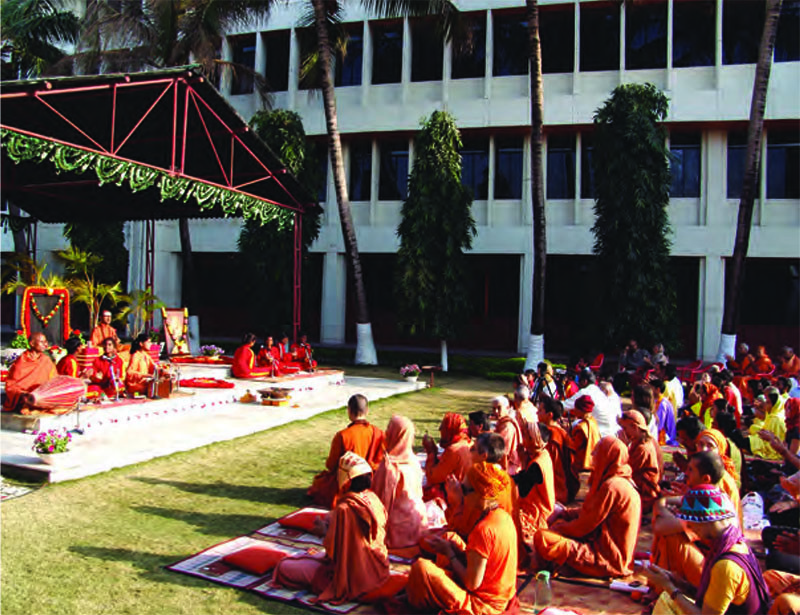
Ganga Darshan Vishwa Yogapeeth, 28 February 2010


From the book “Karma & Karma Yoga, Yogadrishti Series”, pg. 66-67, Sw. Niranjanananda Saraswati


Satyanandashram Hellas

Alithias 1, 19002 Paiania, Greece

PO Box 22, 19002 Paiania, Greece

+30 210 6644189, +30 210 6028531

info@satyanandayoga.gr

Paiania Meditation Center

Dimarchou Iona Vore (former Diadochou Konstantinou) 32, 19002 Paiania

+30 210 6641545, 695 6482415

sycp@satyanandayoga.gr

Athens Meditation Center

Simetelou 2, 115 28, Athens

210 3311178, 694 2974467

syca@satyanandayoga.gr

Thessaloniki Meditation Center

Proxenou Koromila 1, 54623 Thessaloniki

+30 2310 283109

sycs@satyanandayoga.gr

The trademark Satyanandashram Hellas CENTER OF YOGA® is a trademark owned by Satyanandashram Hellas, Greece and used with permission.
The term SATYANANDA YOGA® is a trademark owned by IYFM and used with permission.
Satyananda Yoga Nidra® is a registered trademark of IYFM used with permission.

How you can be part of this beautiful community of service

You are welcome to come and unite in our efforts to help us accomplish our aims and goals. Our association needs people who are ready to offer their hearts, their skills and ideas as well as monetary contributions, and to integrate their ‘head, heart and hands’ in service.

If you consider the needs of others, we need you.
If you have a generous heart, we need you.
Ιf you have large hands, we need you.
If you have bright ideas, we need you.

Your contributions allow us to reach out to more and more people. Your contributions enable us to support and work towards the fulfilment of the vision of Swami Satyananda, Swami Niranjanananda and their lineage  that of peace and prosperity for all humankind.

X

Transcend the lower mind

Karmas are generated in the mind, and one has to work one’s way through the expressions and behaviour of the lower mind with awareness and understanding in order to access the higher self. How to have access to the higher self?  Detach and attach: Transcend the limitations of the lower mind, establish yourself in the higher mind so that the expression of manas is higher; not self­oriented, but selfless.

The expression of buddhi is not to gratify its own self, but also to make oneself act in a constructive, positive way with the environment and the world. In chitta, the memories which bind us to this life in the form of associations, attachments and identities have to be transcended. Cultivate detachment to move into the higher realms of chitta.

When there is attachment we are in the lower realms of chitta. In attachment is asakti, identification, with every sensorial pleasure, sense object and oneself. That is the lower expression of chitta. Upon developing the anasakta bhava, detachment, subject and object continue to be there but without influence any more. For this to happen, the inner environment has to be balanced.

In the summer you can sit out in the sun only for five minutes but in the winter you can sit out in the sun for a long time comfortably. The sun is the same, but according to the season and environment, at one time you can’t be out in the sun for long and at another time you can.

The season indicates the mood of nature just as we have moods in our mind. Winter, summer, spring or autumn are different moods of Prakriti. In each season you see a change in the world and a corresponding change in yourself.  Just as the seasons indicate the moods of Prakriti, the different states of perception represent our own moods.

Sometimes you blow hot, sometimes you blow cold. All these behaviours are guided by the mood. For a happy person or optimistic person there is happiness all around, and for a frustrated person there is sorrow all around. It’s a mood, it’s an understanding, it’s a perception.

By developing detachment from those subjects and objects which cause conflict in life, which bind one to a sense object, to an idea of pleasure, one comes to the upper levels of chitta where our smriti is transcendental. When the memories are material, you identify with the material and when the memories are transcendental you identify with that which is non­material and transcendental.

One has to become aware of all the experiences in the apara, the lower state of mind, and then reach higher, to the para state; to rise above the selfish tendency and assume a selfless tendency, to diminish the ‘I’ tendency and connect with a higher element.

What is the higher element beyond buddhi, chitta and ahamkara? It is the atman, the spirit. The selfless tendency relates to the spirit.

Ganga Darshan Vishwa Yogapeeth, 28 February 2010


From the book “Karma & Karma Yoga, Yogadrishti Series”, pg. 66-67, Sw. Niranjanananda Saraswati