



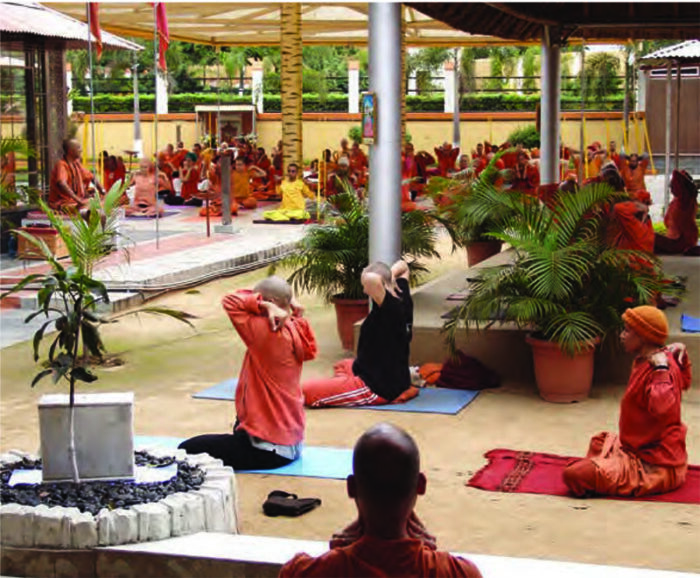
Hatha yoga is a precursor to raja yoga. The practices of hatha yoga lead you to raja yoga and the practices of raja yoga lead you to other higher yogas. Each yoga is a step; no yoga is the final destination. They are steps that take you from one level to another.

Hatha yoga is the starting point; it is like the primary class where you learn the ABCD. Hatha yoga is not asana. It does not even begin with asana; hatha yoga begins with a group of practices known as shatkarma.

The second stage of hatha yoga consists of asana, the third stage of pranayama, the fourth is the practice of mudras and bandhas, and the fifth stage is pratyahara. Hatha yoga gradually develops through these stages.

The starting point of hatha yoga, shatkarma, includes techniques that help clean the body of its toxins. As the toxins leave the body, there is a feeling of lightness, energy and health.

The yogis accord so much importance to detoxification of the body as it also leads to passivity of mind. Once the body is detoxified, the mind becomes quiet and still. Thus, cleansing is the first focus of hatha yoga.

After the cleansing of body has been achieved, the practice of asana, physical postures, comes in. The purpose of the postures in hatha yoga is to provide sthirata, stability. The same concept is conveyed in the Yoga Sutras of Patanjali when he describes that in raja yoga the focus of asanas should be to provide stability and comfort: sthiram sukham asanam.

Hatha yoga also says that through the practice of asana you will acquire sthirata. Hatha yoga does not speak of sukham, comfort; it only speaks of sthirata. The purpose is to allow you to go into higher states of meditation. Therefore, hatha yoga becomes the primary step before raja yoga, and raja yoga becomes the primary step before other higher yogas.

The biggest misconception prevalent in society is that asana is yoga or hatha yoga. Asana is only one component of hatha yoga where physical postures are focused on with the purpose of attaining stability. Pranayama, mudra and bandha are all pranic components, pratyahara is a meditative component and shatkarma is a cleansing component.

Out of the five components of hatha yoga only one component is about postures. The others are in relation to the subtle experiences of energy and learning to stop the dissipations of the mind to move into meditation.

Ganga Darshan Vishwa Yogapeeth, 7 April 2018

From the book “Hatha Yoga Yatra 2, Understanding Asana and Pranayama”, pg. 3-4, Sw. Niranjanananda Saraswati

Satyanandashram Hellas

Alithias 1, 19002 Paiania, Greece

PO Box 22, 19002 Paiania, Greece

+30 210 6644189, +30 210 6028531

info@satyanandayoga.gr

Paiania Meditation Center

Dimarchou Iona Vore (former Diadochou Konstantinou) 32, 19002 Paiania

+30 210 6641545, 695 6482415

sycp@satyanandayoga.gr

Athens Meditation Center

Simetelou 2, 115 28, Athens

210 3311178, 694 2974467

syca@satyanandayoga.gr

Thessaloniki Meditation Center

Proxenou Koromila 1, 54623 Thessaloniki

+30 2310 283109

sycs@satyanandayoga.gr

The trademark Satyanandashram Hellas CENTER OF YOGA® is a trademark owned by Satyanandashram Hellas, Greece and used with permission.
The term SATYANANDA YOGA® is a trademark owned by IYFM and used with permission.
Satyananda Yoga Nidra® is a registered trademark of IYFM used with permission.

How you can be part of this beautiful community of service

You are welcome to come and unite in our efforts to help us accomplish our aims and goals. Our association needs people who are ready to offer their hearts, their skills and ideas as well as monetary contributions, and to integrate their ‘head, heart and hands’ in service.

If you consider the needs of others, we need you.
If you have a generous heart, we need you.
Ιf you have large hands, we need you.
If you have bright ideas, we need you.

Your contributions allow us to reach out to more and more people. Your contributions enable us to support and work towards the fulfilment of the vision of Swami Satyananda, Swami Niranjanananda and their lineage  that of peace and prosperity for all humankind.

X

Understanding Ηatha Υoga

Hatha yoga is a precursor to raja yoga. The practices of hatha yoga lead you to raja yoga and the practices of raja yoga lead you to other higher yogas. Each yoga is a step; no yoga is the final destination. They are steps that take you from one level to another.

Hatha yoga is the starting point; it is like the primary class where you learn the ABCD. Hatha yoga is not asana. It does not even begin with asana; hatha yoga begins with a group of practices known as shatkarma.

The second stage of hatha yoga consists of asana, the third stage of pranayama, the fourth is the practice of mudras and bandhas, and the fifth stage is pratyahara. Hatha yoga gradually develops through these stages.

The starting point of hatha yoga, shatkarma, includes techniques that help clean the body of its toxins. As the toxins leave the body, there is a feeling of lightness, energy and health.

The yogis accord so much importance to detoxification of the body as it also leads to passivity of mind. Once the body is detoxified, the mind becomes quiet and still. Thus, cleansing is the first focus of hatha yoga.

After the cleansing of body has been achieved, the practice of asana, physical postures, comes in. The purpose of the postures in hatha yoga is to provide sthirata, stability. The same concept is conveyed in the Yoga Sutras of Patanjali when he describes that in raja yoga the focus of asanas should be to provide stability and comfort: sthiram sukham asanam.

Hatha yoga also says that through the practice of asana you will acquire sthirata. Hatha yoga does not speak of sukham, comfort; it only speaks of sthirata. The purpose is to allow you to go into higher states of meditation. Therefore, hatha yoga becomes the primary step before raja yoga, and raja yoga becomes the primary step before other higher yogas.

The biggest misconception prevalent in society is that asana is yoga or hatha yoga. Asana is only one component of hatha yoga where physical postures are focused on with the purpose of attaining stability. Pranayama, mudra and bandha are all pranic components, pratyahara is a meditative component and shatkarma is a cleansing component.

Out of the five components of hatha yoga only one component is about postures. The others are in relation to the subtle experiences of energy and learning to stop the dissipations of the mind to move into meditation.

Ganga Darshan Vishwa Yogapeeth, 7 April 2018

From the book “Hatha Yoga Yatra 2, Understanding Asana and Pranayama”, pg. 3-4, Sw. Niranjanananda Saraswati