







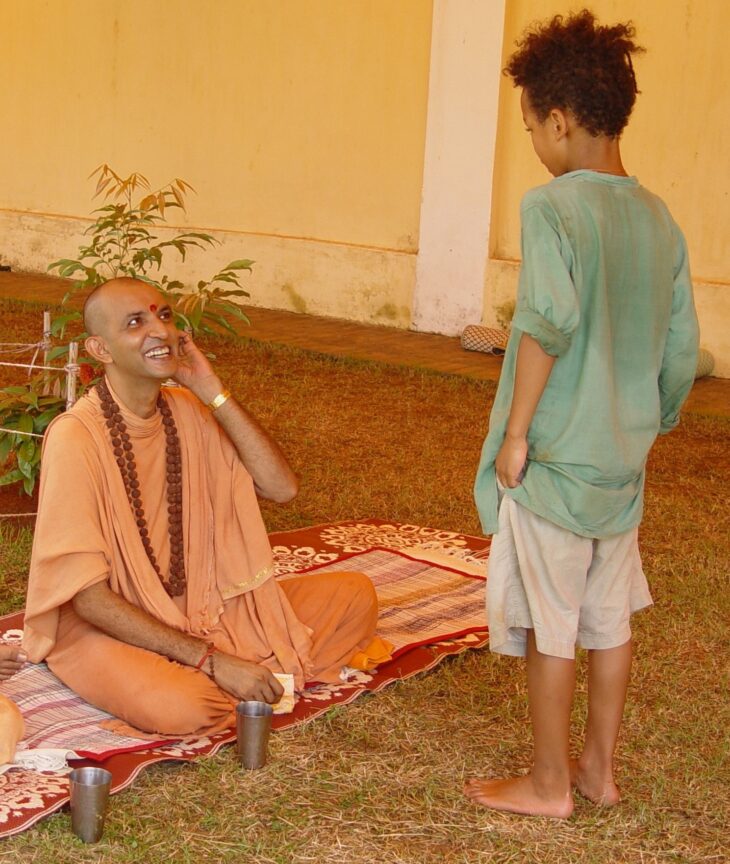
How can sankalpa be used with children? How can we avoid projecting our own desires onto children and how can we help them to be aware of the difficulties in relationships with parents?

Swami Sivananda used to say that children are lumps of clay and you can mould them in any way you want them to be. This is true, but unfortunately we have not been moulded properly and we lack the understanding of how to mould others properly. Although Swami Sivananda’s statement is correct, we cannot apply it. Instead of working with children, as a first step I would recommend that parents work with themselves. It is the general tendency for parents to become the judge, jury and executioner of their children whenever they commit any kind of action. The child always sees the parents as the authority. The parents are the authority figures and the child is always a victim of that authority. No matter how much you may love your child, that image is always there.

The first point yoga suggests is that you should change yourself and try to become a friend to your child. Friendship has a very big influence on the life of a person and the life of a child. Children will listen to and follow what other children say because there are no barriers; they see each other as equals. Even when they are grown up, the concept of equality between friends matures. You remain friends with those who were your friends in childhood and you avoid those whom you placed on the pedestal of authority. If you see your high school teacher walking down the road, you will avoid that teacher if you can. If there is no way of avoiding the teacher, you will say hello but your legs will be shaking. So the first effort that parents have to make is to become friends with their children.

Secondly, after you have become friends with your children you have to encourage them to express their positive nature. As an example, a true story comes to mind about a family who had a small child. Whenever the parents wanted to go to the movies they would tell the child a lie, not that they were going to the movies. But intuitively the child knew that his parents were hiding something from him and he began to rebel against their instructions. It was an intuitive response. Adults function at the level of intellect, but children function at the level of intuition. Therefore, they are able to pick up many things intuitively which adults try to hide from them intellectually. They know when someone is telling them a lie and they know when somebody is telling them the truth. They know when somebody is trying to control them and they know when somebody is trying to let them be free. Their responses are different, their expressions are different, their eyes are different, their smiles are different in every situation.

Once you have become friends with your child, if you are able to encourage them to express their feelings by being truthful with them, then you do not need to have a sankalpa especially modified or made for children, because they learn by example. We all learn by example, but we cannot sustain the example in our lives for long due to our conditioning or our belief or our lifestyle, whatever the mentality, whatever the reason. But children learn by example and they live by example. So being truthful to your child will automatically bring out the best in them.

Thirdly, if you feel the child is inhibited in some areas of his or her nature or personality, such as shyness or an inability to interact with other children of the same age group, having difficulties relating to people, having some form of insecurity or inhibition, having difficulties with study, with concentration, retention and memory, then you can begin with simple sankalpas which encourage positive expression in the child’s life. One very broad and basic sankalpa which we generally give to little children is, “I am creative.” It is very simple. Give your child this sankalpa and also give your child the opportunity to become creative in life, because it is no use giving a sankalpa without giving the opportunity. If you give a sankalpa then you also have to give the right opportunity.

So, from my perspective, it is the parents who have to do the hard work, not the children. Children simply have to be encouraged to express themselves.

Swami Niranjanananda Saraswati, Aube, France, April 1997

satyananda yoga logo

Satyanandashram Hellas

Alithias 1, 19002 Paiania, Greece

PO Box 22, 19002 Paiania, Greece

+306947009660

info@satyanandayoga.gr

Paiania Meditation Center

Dimarchou Iona Vore (former Diadochou Konstantinou) 32, 19002 Paiania

+30 210 6641545, 695 6482415

sycp@satyanandayoga.gr

Athens Meditation Center

Simetelou 2, 115 28, Athens

210 3311178, 694 2974467

syca@satyanandayoga.gr

Thessaloniki Meditation Center

Proxenou Koromila 1, 54623 Thessaloniki

+30 2310 283109

sycs@satyanandayoga.gr

The trademark Satyanandashram Hellas CENTER OF YOGA® is a trademark owned by Satyanandashram Hellas, Greece and used with permission.
The term SATYANANDA YOGA® is a trademark owned by IYFM and used with permission.
Satyananda Yoga Nidra® is a registered trademark of IYFM used with permission.

How you can be part of this beautiful community of service

You are welcome to come and unite in our efforts to help us accomplish our aims and goals. Our association needs people who are ready to offer their hearts, their skills and ideas as well as monetary contributions, and to integrate their ‘head, heart and hands’ in service.

If you consider the needs of others, we need you.
If you have a generous heart, we need you.
Ιf you have large hands, we need you.
If you have bright ideas, we need you.

Your contributions allow us to reach out to more and more people. Your contributions enable us to support and work towards the fulfilment of the vision of Swami Satyananda, Swami Niranjanananda and their lineage  that of peace and prosperity for all humankind.

X

Parents and children

How can sankalpa be used with children? How can we avoid projecting our own desires onto children and how can we help them to be aware of the difficulties in relationships with parents?

Swami Sivananda used to say that children are lumps of clay and you can mould them in any way you want them to be. This is true, but unfortunately we have not been moulded properly and we lack the understanding of how to mould others properly. Although Swami Sivananda's statement is correct, we cannot apply it. Instead of working with children, as a first step I would recommend that parents work with themselves. It is the general tendency for parents to become the judge, jury and executioner of their children whenever they commit any kind of action. The child always sees the parents as the authority. The parents are the authority figures and the child is always a victim of that authority. No matter how much you may love your child, that image is always there.

The first point yoga suggests is that you should change yourself and try to become a friend to your child. Friendship has a very big influence on the life of a person and the life of a child. Children will listen to and follow what other children say because there are no barriers; they see each other as equals. Even when they are grown up, the concept of equality between friends matures. You remain friends with those who were your friends in childhood and you avoid those whom you placed on the pedestal of authority. If you see your high school teacher walking down the road, you will avoid that teacher if you can. If there is no way of avoiding the teacher, you will say hello but your legs will be shaking. So the first effort that parents have to make is to become friends with their children.

Secondly, after you have become friends with your children you have to encourage them to express their positive nature. As an example, a true story comes to mind about a family who had a small child. Whenever the parents wanted to go to the movies they would tell the child a lie, not that they were going to the movies. But intuitively the child knew that his parents were hiding something from him and he began to rebel against their instructions. It was an intuitive response. Adults function at the level of intellect, but children function at the level of intuition. Therefore, they are able to pick up many things intuitively which adults try to hide from them intellectually. They know when someone is telling them a lie and they know when somebody is telling them the truth. They know when somebody is trying to control them and they know when somebody is trying to let them be free. Their responses are different, their expressions are different, their eyes are different, their smiles are different in every situation.

Once you have become friends with your child, if you are able to encourage them to express their feelings by being truthful with them, then you do not need to have a sankalpa especially modified or made for children, because they learn by example. We all learn by example, but we cannot sustain the example in our lives for long due to our conditioning or our belief or our lifestyle, whatever the mentality, whatever the reason. But children learn by example and they live by example. So being truthful to your child will automatically bring out the best in them.

Thirdly, if you feel the child is inhibited in some areas of his or her nature or personality, such as shyness or an inability to interact with other children of the same age group, having difficulties relating to people, having some form of insecurity or inhibition, having difficulties with study, with concentration, retention and memory, then you can begin with simple sankalpas which encourage positive expression in the child's life. One very broad and basic sankalpa which we generally give to little children is, "I am creative." It is very simple. Give your child this sankalpa and also give your child the opportunity to become creative in life, because it is no use giving a sankalpa without giving the opportunity. If you give a sankalpa then you also have to give the right opportunity.

So, from my perspective, it is the parents who have to do the hard work, not the children. Children simply have to be encouraged to express themselves.

Swami Niranjanananda Saraswati, Aube, France, April 1997