







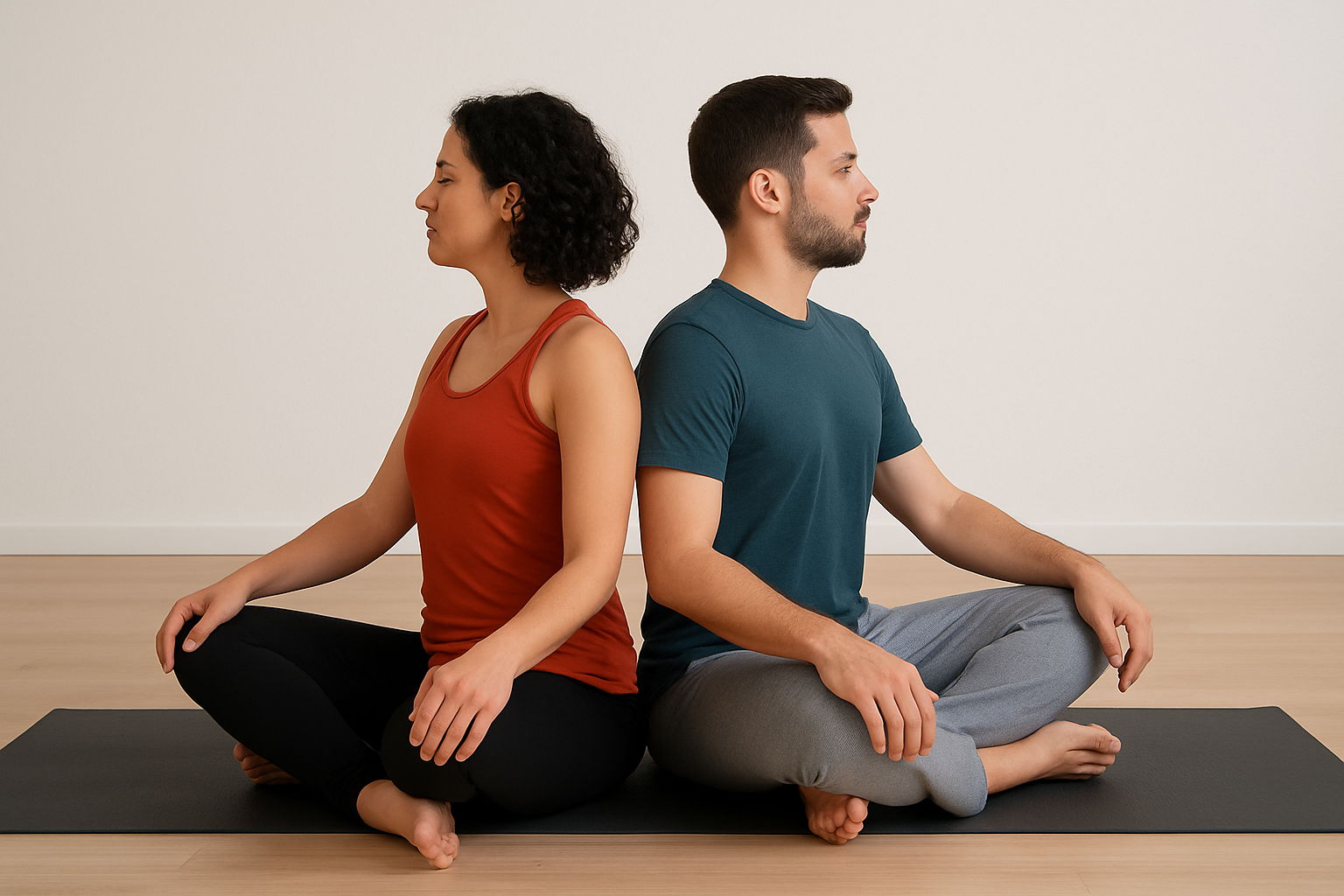

Doing asanas with a partner involves two people working together to perform yoga poses. This practice can offer a range of physical, emotional, and relational benefits beyond what solo practice typically provides.
Partner yoga poses: A Fun and relaxing activity for two
Partner yoga poses are very popular with children, but even as adults you can find the child in you and practice some of these with one of your yoga classmates or friends. The benefits provided by such practices are indeed astounding.
- Improved Flexibility: Partner support can help deepen stretches safely and ease into poses you may not reach on your own.
- Better Alignment : A partner can help you correct posture and alignment by offering physical feedback and support.
- Enhanced Strength and Balance : Supporting each other's weight will challenge your balance and strengthen your muscles, especially the core and stabilizers.
- Assisted Relaxation: In restorative poses, your partner can help you relax more deeply by providing support or gentle pressure.
- Increased Trust and Communication: Partner yoga requires verbal and nonverbal communication, fostering a deeper sense of trust and connection.
- Reduced Stress and Anxiety: The physical touch, synchronized breathwork, and cooperative movement can promote calmness and reduce cortisol levels.
- Mindfulness and Presence: Being attuned to another person's movement encourages present-moment awareness and deep focus.
- Deepened Connection: Whether with a friend, partner, teacher or parent with child, pair yoga can strengthen your relationship through shared intention and energy.
- Mutual Support and Empathy: Learning to give and receive support physically can translate to emotional empathy both on and off the mat.
Easy partner yoga poses
Partner forward fold
The partner forward fold asana (also called double seated forward bend) is a gentle and effective yoga pose that promotes flexibility, connection, and trust between partners.
- Starting Position: Sit facing each other, legs extended forward and feet touching (or slightly apart if flexibility is limited).Keep the legs straight and engage your thigh muscles. Sit tall with a straight spine.
- Hold Hands or Wrists: Reach forward and hold each other’s hands, forearms, or wrists.You may choose a cross-grip or a same-side grip for comfort.
- Alternating the Fold: One partner slowly begins to lean back, gently pulling the other partner into a forward fold.The folding partner should hinge from the hips, keeping the spine long (avoid rounding the back too much).The pulling partner should maintain a controlled and stable lean without jerking or over-pulling.
- Breathing and Switching: Stay in the pose for 5–10 deep breaths.Slowly return to upright, then switch roles.
Benefits:
Stretches the hamstrings, calves, and lower back. Enhances connection and communication. Builds trust and support. Encourages mindful breathing and relaxation.
Contraindications and Precautions:
- Communicate clearly with your partner—never pull forcefully.
- Keep knees slightly bent if you feel too much tension.
- Avoid this pose if you have lower back injuries or tight hamstrings—modify with props or bend the knees.
Double seated twist

The Double Seated Twist (also known as Seated Back-to-Back Twist) is a gentle, grounding yoga pose that promotes spinal mobility, detoxification, and a deeper connection with a partner.
- Starting Position : Sit back-to-back with your partner in a comfortable cross-legged or extended-leg position. Sit up tall, grounding through the hips and aligning your spines vertically.
- Inhale – Find Length: On an inhale, both partners lengthen through the spine, reaching the crown of the head upward.
- Exhale – Twist On an exhale, both partners twist to the right.
Each person places their right hand on their own left knee or thigh. Extend the left hand behind your back to hold your partner’s right knee or thigh (or link arms, depending on comfort and flexibility).Maintain a tall spine and open chest. Gaze over the right shoulder.
- Stay in the twist for 5–8 breaths. Then return to center and repeat the twist to the left.
Benefits: Improves spinal flexibility and posture. Stimulates digestion and internal organs. Enhances awareness, breath coordination, and partner connection.
Contraindications and precautions:
Avoid forcing the twist—twist from the ribs and spine, not the arms. Keep shoulders relaxed and down. Modify or avoid this pose if you have had recent spinal or abdominal injuries.
More challenging partner yoga poses

The flying partner pose refers to a foundational partner pose where one person (the flyer) is lifted and balanced in the air by another person (the base), typically supported on the base’s feet or hands it blends acrobatic elements with yoga principles like alignment, breath, and trust.
The base: This is the person lying on the ground, providing support with legs and hands usually lifted at 90°.
The flyer: is the person lifted into the air, maintaining balance and body tension, who engages core muscles, keeps limbs active, and distributes weight evenly.
The base lies on their back, lifts their legs and places their feet on the flyer’s hips. The flyer leans forward with a straight body, balancing on the base’s feet like a “Superman” position. The flyer's hands may be held for balance or released for a more advanced variation. The base person needs to keep legs strong and stable, maintain hip and knee alignment, and use their arms for balance.
Benefits: Develops trust and communication. Both partners must clearly communicate intentions, weight shifts, and boundaries. Enhances body awareness.
Stambhan asana (posture of retention)[1]
This asana requires the participation of two people of similar height and build. Lie on the back with the crown of your head touching the other person. The arms rest beside the body with the legs and feet together. The two bodies are in a single straight line. Stretch the arms out to the sides at shoulder level and take hold of each other's hands.
Tense the arms keeping them flat on the floor with the elbows straight throughout the practice. The tops of the heads press against each other. This is the starting position.
Partner one raises both legs keeping them together until they are perpendicular to the floor. Hold this position for a few seconds and then lower the legs to the floor. Again, the same partner raises both legs and this time buttocks from the floor and lowers the legs into a horizontal position over the partner so that the toes are above the partner's navel. Hold the position for a few seconds, then slowly lower the legs and buttocks to the floor resuming the starting position.
Partner two then performs the practice in the same way.
Awareness: synchronizing movement with the other partner or focusing on manipura chakra.
Benefits: activates internal peristalsis improving digestion and removing constipation. It facilitates the breakdown of fats by exercising the liver and the gall bladder and stretches the pelvic region.
Contra-indications: This pose should not be practiced by those with sciatica, or other back and neck ailments or by people with high blood pressure.
[1] Swami Satyananda Saraswati, Asana Pranyama Mudra Bandha (Munger: Bihar School of Yoga, 1999), 277.