



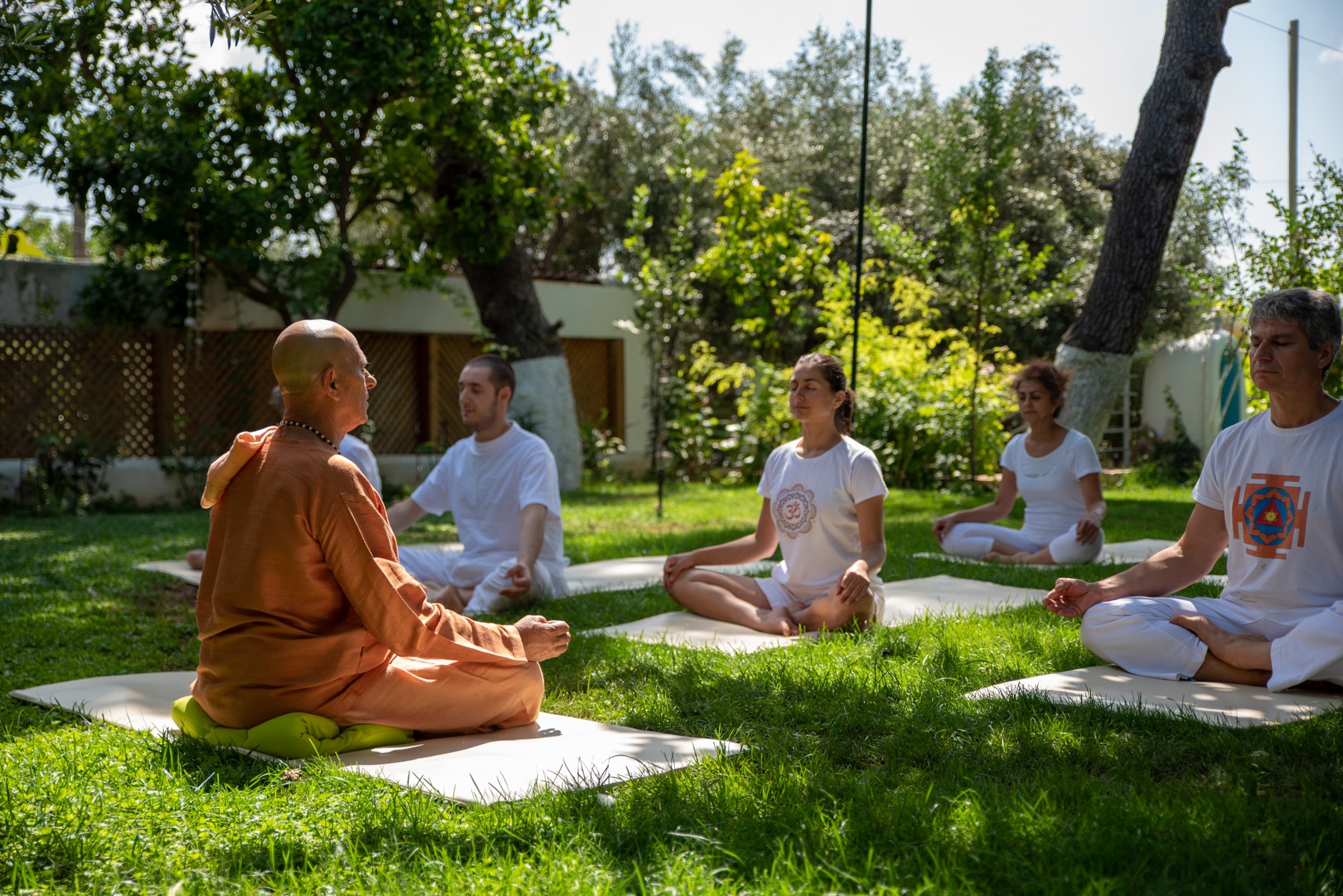
Yoga is not an ancient myth buried in oblivion. It is the most valuable inheritance of the present. It is the essential need of today and the culture of tomorrow.

—Swami Satyananda Saraswati

Yoga is the science of right living and, as such, is intended to be incorporated in daily life. It works on all aspects of the person: the physical, vital, mental, emotional, psychic and spiritual.

Meaning of the word “yoga”

The word yoga means ‘unity’ or ‘oneness’ and is derived from the Sanskrit word yuj, which means ‘to join’. This unity or joining is described in spiritual terms as the union of the individual consciousness with the universal consciousness. On a more practical level, yoga is a means of balancing and harmonizing the body, mind and emotions. This is done through the practice of asana, pranayama, mudra, bandha, shatkarma and meditation, and must be achieved before union can take place with the higher reality.


Science of yoga

The science of yoga begins to work on the outermost aspect of the personality, the physical body, which for most people is a practical and familiar starting point. When imbalance is experienced at this level, the organs, muscles and nerves no longer function in harmony; rather they act in opposition to each other. For instance, the endocrine system might become irregular and the efficiency of the nervous system decrease to such an extent that a disease will manifest. Yoga aims at bringing the different bodily functions into perfect coordination so that they work for the good of the whole body.

From the physical body, yoga moves on to the mental and emotional levels. Many people suffer from phobias and neuroses as a result of the stresses and interactions of everyday living. Yoga cannot provide a cure for life, but it does present a proven method for coping with it.

Swami Sivananda Saraswati of Rishikesh explained yoga as an “. . . integration and harmony between thought, feeling and deed, or integration between head, heart and hand”. Through the practices of yoga, awareness develops of the interrelation between the emotional, mental and physical levels, and how a disturbance in any one of these affects the others. Gradually, this awareness leads to an understanding of the more subtle areas of existence.

What are the different branches of yoga?

There are many branches of yoga: raja, hatha, jnana, karma, bhakti, mantra, kundalini and laya, to name but a few, and many texts explain them in detail. Each individual needs to find those yogas most suited to his or her particular personality and need. In the last half of the twentieth century, hatha yoga had become the most well-known and widely practised of the systems. However, the concept of what constitutes yoga is broadening as more people take it up, and this knowledge is spreading. In the ancient texts, hatha yoga consists of the shatkarmas, cleansing practices, only. Today, however, hatha yoga commonly embraces the practices of asana, pranayama, mudra and bandha as well.


satyananda yoga logo

Satyanandashram Hellas

Alithias 1, 19002 Paiania, Greece

PO Box 22, 19002 Paiania, Greece

+306947009660

info@satyanandayoga.gr

Paiania Meditation Center

Dimarchou Iona Vore (former Diadochou Konstantinou) 32, 19002 Paiania

+30 210 6641545, 695 6482415

sycp@satyanandayoga.gr

Athens Meditation Center

Simetelou 2, 115 28, Athens

210 3311178, 694 2974467

syca@satyanandayoga.gr

Thessaloniki Meditation Center

Proxenou Koromila 1, 54623 Thessaloniki

+30 2310 283109

sycs@satyanandayoga.gr

The trademark Satyanandashram Hellas CENTER OF YOGA® is a trademark owned by Satyanandashram Hellas, Greece and used with permission.
The term SATYANANDA YOGA® is a trademark owned by IYFM and used with permission.
Satyananda Yoga Nidra® is a registered trademark of IYFM used with permission.

How you can be part of this beautiful community of service

You are welcome to come and unite in our efforts to help us accomplish our aims and goals. Our association needs people who are ready to offer their hearts, their skills and ideas as well as monetary contributions, and to integrate their ‘head, heart and hands’ in service.

If you consider the needs of others, we need you.
If you have a generous heart, we need you.
Ιf you have large hands, we need you.
If you have bright ideas, we need you.

Your contributions allow us to reach out to more and more people. Your contributions enable us to support and work towards the fulfilment of the vision of Swami Satyananda, Swami Niranjanananda and their lineage  that of peace and prosperity for all humankind.

X

Introduction to Yoga

Yoga is not an ancient myth buried in oblivion. It is the most valuable inheritance of the present. It is the essential need of today and the culture of tomorrow.

—Swami Satyananda Saraswati

Yoga is the science of right living and, as such, is intended to be incorporated in daily life. It works on all aspects of the person: the physical, vital, mental, emotional, psychic and spiritual.

Meaning of the word "yoga"

The word yoga means ‘unity’ or ‘oneness’ and is derived from the Sanskrit word yuj, which means ‘to join’. This unity or joining is described in spiritual terms as the union of the individual consciousness with the universal consciousness. On a more practical level, yoga is a means of balancing and harmonizing the body, mind and emotions. This is done through the practice of asana, pranayama, mudra, bandha, shatkarma and meditation, and must be achieved before union can take place with the higher reality.


Science of yoga

The science of yoga begins to work on the outermost aspect of the personality, the physical body, which for most people is a practical and familiar starting point. When imbalance is experienced at this level, the organs, muscles and nerves no longer function in harmony; rather they act in opposition to each other. For instance, the endocrine system might become irregular and the efficiency of the nervous system decrease to such an extent that a disease will manifest. Yoga aims at bringing the different bodily functions into perfect coordination so that they work for the good of the whole body.

From the physical body, yoga moves on to the mental and emotional levels. Many people suffer from phobias and neuroses as a result of the stresses and interactions of everyday living. Yoga cannot provide a cure for life, but it does present a proven method for coping with it.

Swami Sivananda Saraswati of Rishikesh explained yoga as an “. . . integration and harmony between thought, feeling and deed, or integration between head, heart and hand”. Through the practices of yoga, awareness develops of the interrelation between the emotional, mental and physical levels, and how a disturbance in any one of these affects the others. Gradually, this awareness leads to an understanding of the more subtle areas of existence.

What are the different branches of yoga?

There are many branches of yoga: raja, hatha, jnana, karma, bhakti, mantra, kundalini and laya, to name but a few, and many texts explain them in detail. Each individual needs to find those yogas most suited to his or her particular personality and need. In the last half of the twentieth century, hatha yoga had become the most well-known and widely practised of the systems. However, the concept of what constitutes yoga is broadening as more people take it up, and this knowledge is spreading. In the ancient texts, hatha yoga consists of the shatkarmas, cleansing practices, only. Today, however, hatha yoga commonly embraces the practices of asana, pranayama, mudra and bandha as well.