



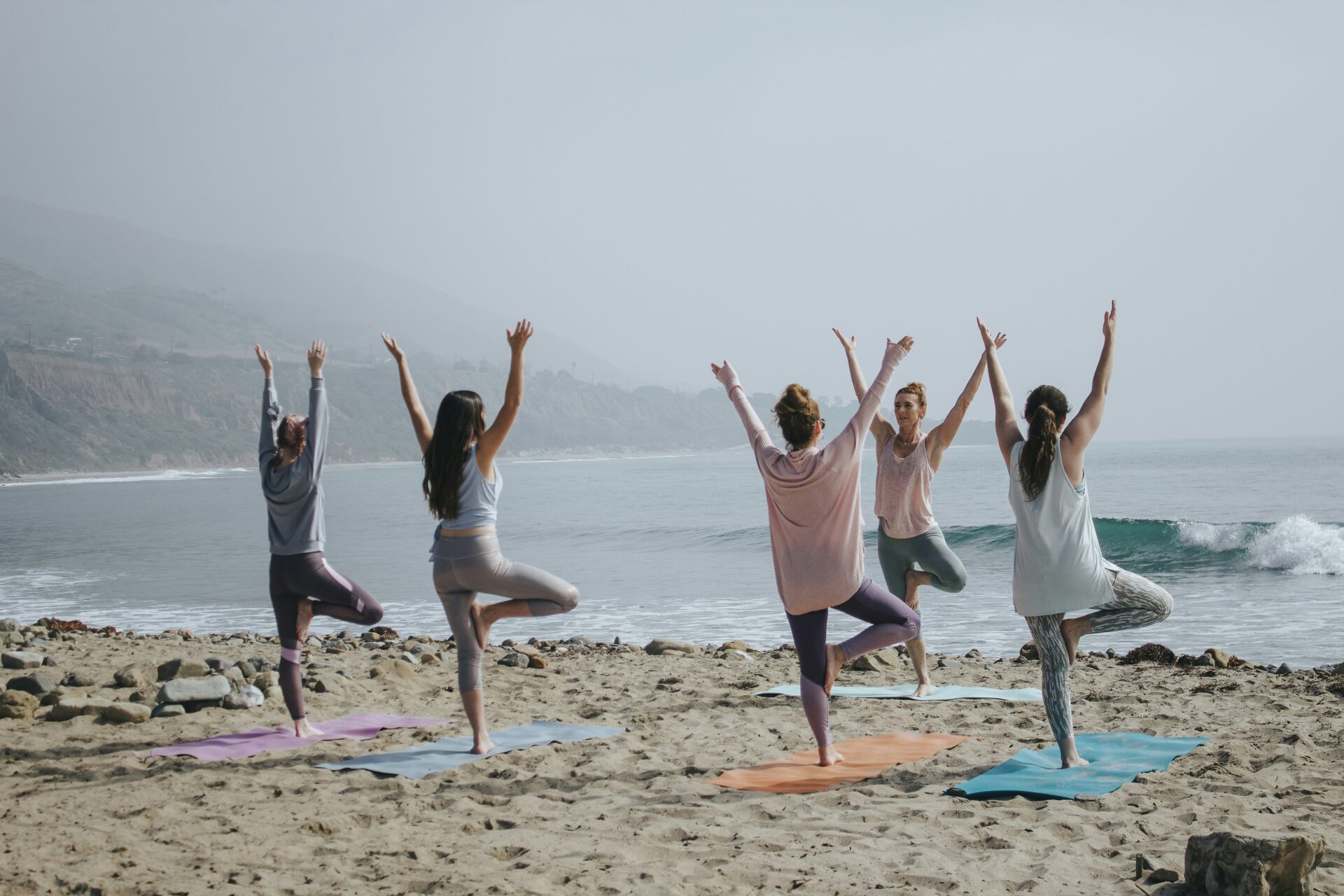
Benefits of yoga poses for balance

Most people are uncoordinated in their movements so their bodies need to compensate for their lack of balance in order to avoid falling or knocking into things which creates additional strain both on the body and the mind. This is why balancing asanas are so important in your yoga routine.

When performing balancing asanas, all the different functions of the body are harmonized, and muscle coordination greatly improves together with your posture which induces physical and nervous balance. Also, unconscious movement is stilled thus conserving energy and enabling you to move with grace and fluidity.

Another plus is that mental stability is practiced in balancing asanas since you need to maintain equilibrium in the final pose, so mental concentration is absolutely necessary. You cannot reach balance if your mind is jumping from one thought to another. By focusing on your balance, stress and nervousness are removed and as a result a state of mental equanimity is established. The focus to perform these asanas with steadiness develops concentration and balance at the emotional, mental and psychic levels.


Balance yoga poses for beginners

Balancing asanas (yoga poses) offer a range of benefits, especially for beginners who are just starting to build strength, awareness, and control over their body and mind.

These poses improve proprioception (that has to do with the sense of where your body is in space) which is essential for coordination and injury prevention. Another benefit is that balancing engages deep core muscles, hips, and legs which in turn build foundational strength and prepare the body for more advanced postures.

Better posture and alignment are also attained as these asanas correct habitual misalignments and encourage proper spinal alignment and posture. From a mental and emotional perspective, these asanas teach resilience, patience, and calmness under pressure or during a frustrating situation because balancing often involves falling and trying again. Apart from this, they are good fun to have a little giggle at yourself while trying to maintain some sort of balance on the mat.


Ekapadapranamasana (one legged prayer pose)[1]

This is a beginner’s favourite pose which can be done in stages of difficulty.

Stand upright with feet together and arms at sides. Focus your gaze at a fixed point in front of you at eye level. Bend the right leg and place the sole of the foot on the inside of the left ankle. The right knee should point out to the side[not in front]. Once you find balance, bring palms in front of heart in prayer pose. Once you feel comfortable, you can move into a more challenging balancing pose by bringing the sole of the foot to rest on the inside of the left leg’s calf muscle. Be sure you do not place the sole of foot of inside of the knee joint as this could injure the knee. For the complete pose, you can place the sole of the foot on the inside of the left thigh. The heel should be close to the perineum and the right knee points out towards the side.

Breathe normally and hold the pose for up to 2 minutes. Try not to lock the knee you are balancing on. Then change legs.

A variation of this pose is to keep the gaze focused at eye level, inhale and raise arms above head joining palms together. Hold the position with breath inside, and on exhalation lower the hands to the chest.

Awareness: focus your awareness behind eyebrow centre or at ajna chakra or at the space behind  breast bone at anahat chakra.

Benefits: This asana develops nervous balance. It strengthens the legs, ankles and foot muscles.


Natavarasana (Lord Krishna’s pose)[2]

Stand with feet together and focus on a fixed point at eye level. Place the left foot to the outside of the left calf with the toes above the floor and the sole of the foot almost vertical. Rest the side of the right calf against the left shin. Raise both hands to the right as if playing a flute. The right palm faces forward and the left palm backward. The index and the little fingers of the hands are straight and the middle fingers are bent. Turn the head slightly to the left and focus the eyes at a point on the floor. Hold the final position for as long as is comfortable. Breathe normally and hold pose for up to 2 minutes Then lower the arms to the sides and the raised foot to the floor. Repeat the stance on the other side.

This stance is good for beginners because when practicing balance, you can lower the raised foot to touch the floor at any time you lose balance r giving you more security until you are ready to resume the final posture by raising the foot again.

Awareness: Focus your awareness on eyebrow centre or ajna chakra

Benefits: This asana develops nervous balance and enhances concentration.


Garudasana (eagle pose)[3]

Assume standing position and focus the gaze on a fixed point on the floor in front of the body. Bend the right leg and twist it around the left leg. The right thigh is in front of the left thigh and the top of the right foot rests on the calf of the left leg. Bend the elbows and bring them in front of the chest. Twist the forearms around each other with the left elbow remaining below. If possible, join the palms in front of your face. The palms resemble an eagle’s beak. Slowly bend the left knee you are balancing on until the tip of the right toe touches the floor. Keep eyes focused on the fixed point. Hold the final position for as long as is comfortable. Then release the posture and stand with the eyes closed for a few moments feeling the effects of the asana on the physical, the pranic, the mental and emotional bodies.

Then repeat the posture with the opposite legs and arms.

Breathe normally throughout the practice.

Awareness: Focus your awareness on perineum or mooladhara chakra.

Benefits: This asana strengthens the muscles, tones the nerves and loosens the joints of the legs and arms. It relives sciatica, rheumatism and hydrocele.


How to master yoga balance poses?

Moving into advanced balancing yoga poses requires greater physical strength, body awareness, mental focus, practice and patience. So, you can start by start by mastering the foundational poses such as, tadasana (palm tree pose), garudasana (eagle pose), the preparatory natarajasana (Lord Shiva’s pose).

To improve and do more advanced asanas you can work on the following key points below:

  1. 1. Train your focus by practicing a steady gaze (known as drishti) on a point at eye level together with slow conscious breathing to stay present and centred. If you know ujjayi breath, you can coordinate your movement with ujjayi which enables you to be more relaxed.
  2. 2. Strengthen core muscles (for example the deep abdominal muscles) and the stabilizer muscles(located in the shoulders, hip, lower legs and feet). Core strength is essential for balance, this means that you need to practice asanas such as

Santolasana (balancing asana or plank pose) [p. 319]

Naukasana (boat pose) [p.58]

Kandharasana (shoulder pose) [p.214]

Parvatasana (mountain pose) [p.166]

  1. Improve flexibility and mobility by opening hamstrings, hips, and shoulders for poses by regularly incorporating the Pawanmuktasana series in your daily routine.
  2. Progress gradually and move from easier to harder balance poses making sure you use props for example, yoga blocks, a chair or the wall. You can do a modification of an asana from which you get more benefit and satisfaction rather than struggle to achieve the final pose immediately. Remember to listen to your body’s needs so avoid forcing the asana. Rest when needed, and if you’re wobbling a lot, focus on grounding and alignment before pushing further.
  3. 5. Incorporate balance daily in your life. Short, frequent sessions are more effective than occasional long ones. Even 5–10 minutes of balance-focused practice per day makes a difference.
  4. 6. It is true that balance requires mental resilience as much as physical ability. Falling is part of the learning process. Each attempt improves your neuromuscular coordination, so embrace the challenge the asana offers.


Advanced yoga balance poses

Natarajasana (Lord Shiva’s pose) [p.296-297]

Before attempting the final pose, work on the preparatory asana for some time until you feel you have mastered it. [4]

Stand with feet together and focus on a fixed point at eye level. Bend the right knee and grasp the right big toe(in the preparatory version you grasp the  ankle with the right hand) behind the body. In the final version, the elbow of the arm holding the big toe should point upward. This position of the hand and arm will allow the foot to be raised nearer to the back of the head.  Keep both knees together and maintain the balance. Slowly raise and stretch the right leg backwards as high as possible. Make sure the right hip does not twist and the leg is raised directly behind the body. Reach upward and forward with the left arm bringing the tip of the index finger and thumb of the left hand together to form jnana mudra. Focus the gaze on the left hand.

Hold for as long as you feel comfortable. Then relax pose and remain in neutral anatomical pose for a few moments to align body and absorb the benefits of the asana. Then repeat with the left leg.

Awareness: Focus your awareness on maintaining balance while focusing on jnana mudra.

Benefits: This asana strengthens ankles, legs, and core muscles and the back, while improving balance and stability. Opens the chest and shoulders counteracting slouching. Improves focus and concentration calming the mind and reducing stress. When mastering this asana, you can focus on deeper breathing which stimulates the parasympathetic nervous system. This asana activates the heart chakra (Anahata) promoting compassion, openness, and emotional balance.

Contraindications: Avoid or modify this pose if you have lower back pain or injury, shoulder or knee problems.

Eka padasana (one foot pose)[p.298]

Relax the body in the standing position with the feet together. Raise the arms directly above the head and interlock the fingers with the palms. Bend forward slowly from the hips keeping the trunk, head and arms in a straight line. Simultaneously, raise the left leg straight back keeping it in line with the trunk. The body should pivot from the right hip joint. In the final position, the left leg, trunk, head and the arms are all in one straight horizontal line. The right leg is straight and vertical. Focus the gaze on the hands.

Hold the final position for as long as is comfortable then slowly return to starting position and repeat by raising the right leg back.

This asana can be used a preliminary to bakarasana (crane pose).

Awareness: Focus your awareness on maintaining balance while focusing on swadhisthana or manipura chakra.

Benefits: This asana strengthens the arms, wrists, hips and leg muscles. It relaxes lower back and helps develop nervous coordination.

Contraindications: People with high blood pressure should not do this asana.

Bakasana (crane pose) [p.299]

Relax in the standing position with the feet together. Raise the arms in front of the body over the head. Bend forward from the hips and grasp the toes of the right foot with both hands. Slowly stretch the left leg behind raising it as high as possible and bring the forehead towards the knees. Keep both legs straight. Lower the leg and return to the upright position. Change legs and repeat the practice.

Benefits: Strengthens the hip and leg muscles. Improves blood circulation to the brain  and helps develop nervous coordination.

A large and varied range of balancing asanas can be found in the book Hatha Yoga Book 4 Asana published by Yoga Publications Trust in Munger, India.

[1] Swami Satyananda Saraswati, Asana Pranayama, Mudra Bandha Bihar School of Yoga, Munger, 1999 p.291

[2] Ibid., 292

[3]Ibid., 294

[4] Ibid., 296

satyananda yoga logo

Satyanandashram Hellas

Alithias 1, 19002 Paiania, Greece

PO Box 22, 19002 Paiania, Greece

+306947009660

info@satyanandayoga.gr

Paiania Meditation Center

Dimarchou Iona Vore (former Diadochou Konstantinou) 32, 19002 Paiania

+30 210 6641545, 695 6482415

sycp@satyanandayoga.gr

Athens Meditation Center

Simetelou 2, 115 28, Athens

210 3311178, 694 2974467

syca@satyanandayoga.gr

Thessaloniki Meditation Center

Proxenou Koromila 1, 54623 Thessaloniki

+30 2310 283109

sycs@satyanandayoga.gr

The trademark Satyanandashram Hellas CENTER OF YOGA® is a trademark owned by Satyanandashram Hellas, Greece and used with permission.
The term SATYANANDA YOGA® is a trademark owned by IYFM and used with permission.
Satyananda Yoga Nidra® is a registered trademark of IYFM used with permission.

How you can be part of this beautiful community of service

You are welcome to come and unite in our efforts to help us accomplish our aims and goals. Our association needs people who are ready to offer their hearts, their skills and ideas as well as monetary contributions, and to integrate their ‘head, heart and hands’ in service.

If you consider the needs of others, we need you.
If you have a generous heart, we need you.
Ιf you have large hands, we need you.
If you have bright ideas, we need you.

Your contributions allow us to reach out to more and more people. Your contributions enable us to support and work towards the fulfilment of the vision of Swami Satyananda, Swami Niranjanananda and their lineage  that of peace and prosperity for all humankind.

X

Practice Stability: Yoga Balance Poses You Can Try at Home

Benefits of yoga poses for balance

Most people are uncoordinated in their movements so their bodies need to compensate for their lack of balance in order to avoid falling or knocking into things which creates additional strain both on the body and the mind. This is why balancing asanas are so important in your yoga routine.

When performing balancing asanas, all the different functions of the body are harmonized, and muscle coordination greatly improves together with your posture which induces physical and nervous balance. Also, unconscious movement is stilled thus conserving energy and enabling you to move with grace and fluidity.

Another plus is that mental stability is practiced in balancing asanas since you need to maintain equilibrium in the final pose, so mental concentration is absolutely necessary. You cannot reach balance if your mind is jumping from one thought to another. By focusing on your balance, stress and nervousness are removed and as a result a state of mental equanimity is established. The focus to perform these asanas with steadiness develops concentration and balance at the emotional, mental and psychic levels.


Balance yoga poses for beginners

Balancing asanas (yoga poses) offer a range of benefits, especially for beginners who are just starting to build strength, awareness, and control over their body and mind.

These poses improve proprioception (that has to do with the sense of where your body is in space) which is essential for coordination and injury prevention. Another benefit is that balancing engages deep core muscles, hips, and legs which in turn build foundational strength and prepare the body for more advanced postures.

Better posture and alignment are also attained as these asanas correct habitual misalignments and encourage proper spinal alignment and posture. From a mental and emotional perspective, these asanas teach resilience, patience, and calmness under pressure or during a frustrating situation because balancing often involves falling and trying again. Apart from this, they are good fun to have a little giggle at yourself while trying to maintain some sort of balance on the mat.


Ekapadapranamasana (one legged prayer pose)[1]

This is a beginner's favourite pose which can be done in stages of difficulty.

Stand upright with feet together and arms at sides. Focus your gaze at a fixed point in front of you at eye level. Bend the right leg and place the sole of the foot on the inside of the left ankle. The right knee should point out to the side[not in front]. Once you find balance, bring palms in front of heart in prayer pose. Once you feel comfortable, you can move into a more challenging balancing pose by bringing the sole of the foot to rest on the inside of the left leg's calf muscle. Be sure you do not place the sole of foot of inside of the knee joint as this could injure the knee. For the complete pose, you can place the sole of the foot on the inside of the left thigh. The heel should be close to the perineum and the right knee points out towards the side.

Breathe normally and hold the pose for up to 2 minutes. Try not to lock the knee you are balancing on. Then change legs.

A variation of this pose is to keep the gaze focused at eye level, inhale and raise arms above head joining palms together. Hold the position with breath inside, and on exhalation lower the hands to the chest.

Awareness: focus your awareness behind eyebrow centre or at ajna chakra or at the space behind  breast bone at anahat chakra.

Benefits: This asana develops nervous balance. It strengthens the legs, ankles and foot muscles.


Natavarasana (Lord Krishna's pose)[2]

Stand with feet together and focus on a fixed point at eye level. Place the left foot to the outside of the left calf with the toes above the floor and the sole of the foot almost vertical. Rest the side of the right calf against the left shin. Raise both hands to the right as if playing a flute. The right palm faces forward and the left palm backward. The index and the little fingers of the hands are straight and the middle fingers are bent. Turn the head slightly to the left and focus the eyes at a point on the floor. Hold the final position for as long as is comfortable. Breathe normally and hold pose for up to 2 minutes Then lower the arms to the sides and the raised foot to the floor. Repeat the stance on the other side.

This stance is good for beginners because when practicing balance, you can lower the raised foot to touch the floor at any time you lose balance r giving you more security until you are ready to resume the final posture by raising the foot again.

Awareness: Focus your awareness on eyebrow centre or ajna chakra

Benefits: This asana develops nervous balance and enhances concentration.


Garudasana (eagle pose)[3]

Assume standing position and focus the gaze on a fixed point on the floor in front of the body. Bend the right leg and twist it around the left leg. The right thigh is in front of the left thigh and the top of the right foot rests on the calf of the left leg. Bend the elbows and bring them in front of the chest. Twist the forearms around each other with the left elbow remaining below. If possible, join the palms in front of your face. The palms resemble an eagle's beak. Slowly bend the left knee you are balancing on until the tip of the right toe touches the floor. Keep eyes focused on the fixed point. Hold the final position for as long as is comfortable. Then release the posture and stand with the eyes closed for a few moments feeling the effects of the asana on the physical, the pranic, the mental and emotional bodies.

Then repeat the posture with the opposite legs and arms.

Breathe normally throughout the practice.

Awareness: Focus your awareness on perineum or mooladhara chakra.

Benefits: This asana strengthens the muscles, tones the nerves and loosens the joints of the legs and arms. It relives sciatica, rheumatism and hydrocele.


How to master yoga balance poses?

Moving into advanced balancing yoga poses requires greater physical strength, body awareness, mental focus, practice and patience. So, you can start by start by mastering the foundational poses such as, tadasana (palm tree pose), garudasana (eagle pose), the preparatory natarajasana (Lord Shiva's pose).

To improve and do more advanced asanas you can work on the following key points below:

  1. 1. Train your focus by practicing a steady gaze (known as drishti) on a point at eye level together with slow conscious breathing to stay present and centred. If you know ujjayi breath, you can coordinate your movement with ujjayi which enables you to be more relaxed.
  2. 2. Strengthen core muscles (for example the deep abdominal muscles) and the stabilizer muscles(located in the shoulders, hip, lower legs and feet). Core strength is essential for balance, this means that you need to practice asanas such as

Santolasana (balancing asana or plank pose) [p. 319]

Naukasana (boat pose) [p.58]

Kandharasana (shoulder pose) [p.214]

Parvatasana (mountain pose) [p.166]

  1. Improve flexibility and mobility by opening hamstrings, hips, and shoulders for poses by regularly incorporating the Pawanmuktasana series in your daily routine.
  2. Progress gradually and move from easier to harder balance poses making sure you use props for example, yoga blocks, a chair or the wall. You can do a modification of an asana from which you get more benefit and satisfaction rather than struggle to achieve the final pose immediately. Remember to listen to your body's needs so avoid forcing the asana. Rest when needed, and if you're wobbling a lot, focus on grounding and alignment before pushing further.
  3. 5. Incorporate balance daily in your life. Short, frequent sessions are more effective than occasional long ones. Even 5–10 minutes of balance-focused practice per day makes a difference.
  4. 6. It is true that balance requires mental resilience as much as physical ability. Falling is part of the learning process. Each attempt improves your neuromuscular coordination, so embrace the challenge the asana offers.


Advanced yoga balance poses

Natarajasana (Lord Shiva's pose) [p.296-297]

Before attempting the final pose, work on the preparatory asana for some time until you feel you have mastered it. [4]

Stand with feet together and focus on a fixed point at eye level. Bend the right knee and grasp the right big toe(in the preparatory version you grasp the  ankle with the right hand) behind the body. In the final version, the elbow of the arm holding the big toe should point upward. This position of the hand and arm will allow the foot to be raised nearer to the back of the head.  Keep both knees together and maintain the balance. Slowly raise and stretch the right leg backwards as high as possible. Make sure the right hip does not twist and the leg is raised directly behind the body. Reach upward and forward with the left arm bringing the tip of the index finger and thumb of the left hand together to form jnana mudra. Focus the gaze on the left hand.

Hold for as long as you feel comfortable. Then relax pose and remain in neutral anatomical pose for a few moments to align body and absorb the benefits of the asana. Then repeat with the left leg.

Awareness: Focus your awareness on maintaining balance while focusing on jnana mudra.

Benefits: This asana strengthens ankles, legs, and core muscles and the back, while improving balance and stability. Opens the chest and shoulders counteracting slouching. Improves focus and concentration calming the mind and reducing stress. When mastering this asana, you can focus on deeper breathing which stimulates the parasympathetic nervous system. This asana activates the heart chakra (Anahata) promoting compassion, openness, and emotional balance.

Contraindications: Avoid or modify this pose if you have lower back pain or injury, shoulder or knee problems.

Eka padasana (one foot pose)[p.298]

Relax the body in the standing position with the feet together. Raise the arms directly above the head and interlock the fingers with the palms. Bend forward slowly from the hips keeping the trunk, head and arms in a straight line. Simultaneously, raise the left leg straight back keeping it in line with the trunk. The body should pivot from the right hip joint. In the final position, the left leg, trunk, head and the arms are all in one straight horizontal line. The right leg is straight and vertical. Focus the gaze on the hands.

Hold the final position for as long as is comfortable then slowly return to starting position and repeat by raising the right leg back.

This asana can be used a preliminary to bakarasana (crane pose).

Awareness: Focus your awareness on maintaining balance while focusing on swadhisthana or manipura chakra.

Benefits: This asana strengthens the arms, wrists, hips and leg muscles. It relaxes lower back and helps develop nervous coordination.

Contraindications: People with high blood pressure should not do this asana.

Bakasana (crane pose) [p.299]

Relax in the standing position with the feet together. Raise the arms in front of the body over the head. Bend forward from the hips and grasp the toes of the right foot with both hands. Slowly stretch the left leg behind raising it as high as possible and bring the forehead towards the knees. Keep both legs straight. Lower the leg and return to the upright position. Change legs and repeat the practice.

Benefits: Strengthens the hip and leg muscles. Improves blood circulation to the brain  and helps develop nervous coordination.

A large and varied range of balancing asanas can be found in the book Hatha Yoga Book 4 Asana published by Yoga Publications Trust in Munger, India.

[1] Swami Satyananda Saraswati, Asana Pranayama, Mudra Bandha Bihar School of Yoga, Munger, 1999 p.291

[2] Ibid., 292

[3]Ibid., 294

[4] Ibid., 296