



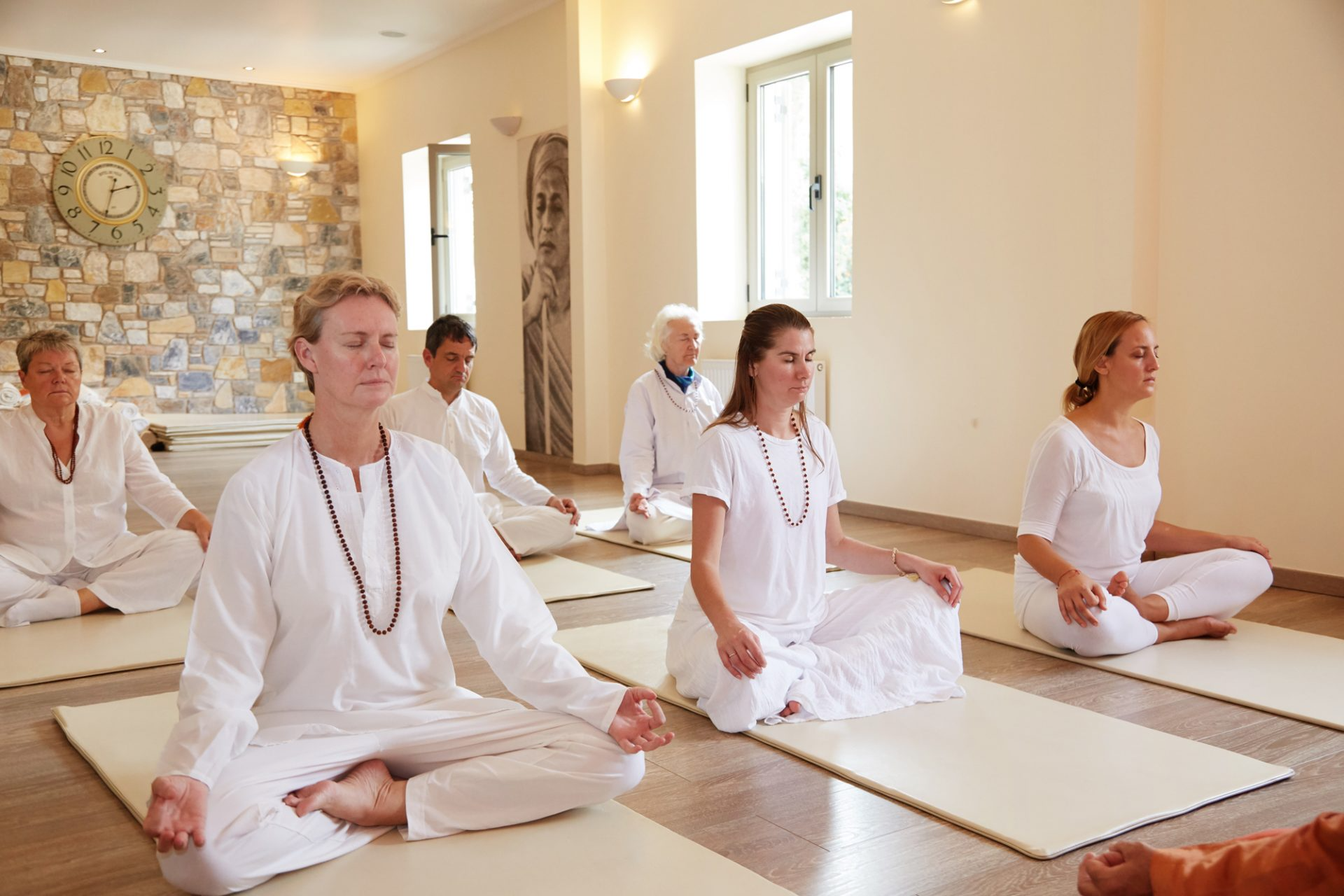
Meditation practice is simply dedicating quiet time to oneself. It’s the opportunity to introvert, reflect and to come into contact with the inner positive Self. It is a technique for self-knowledge, peace, joy and equanimity. A common misunderstanding of meditation is that one stops thoughts. It is definitely not a practice to block out or suppress thoughts and events that are constantly affecting our day-to-day life. But let’s take a closer look at what meditation actually is.

The stages of meditation 

Stage 1: Pratyahara

The first stage in meditation is to withdraw the mind from the senses and the sense objects. For example, withdrawing our awareness from the images in our environment that continually distract us, and this is why we close our eyes. Then there are the noises and smells in our environment that we continuously react to, the tastes in our mouth, the sensations in and on our body. Meditation is not possible if the mind is overwhelmed by continuous reactions to the sense impressions. So, pratyahara implies a practice which internalizes the senses and  enables the mind to become internalized at will.  In this stage we are aware of what is happening inside the mind and outside, in the external world simultaneously. We are on the threshold. In fact, we enter pratyahara when we go to sleep every night ; it is that stage when you’re starting to fall asleep when you are between external awareness and internal awareness, but you do it unconsciously.  Try and catch that moment when you are leaving the waking state and entering the dreaming state without becoming unconscious. In the same way, in the morning when you wake up from the dream, you are in that very sweet state, hanging in the balance  before you actually wake up and become conscious. It is that semi-conscious state, that threshold which can describe the  state of pratyahara. 

It is not easy for us to introvert ourselves and that’s shown as soon as we become introverted, we fall asleep.  Instead of holding that state of relaxation, we become unconscious.  It is said that one of the greatest obstacles to anyone on the path into dharana (the state of one-pointedness) or dhyana (the state of  meditation) is when we become so relaxed we fall asleep  because we cannot hold that relaxed mental state. But it is essential to do this if we want to enter into the next stage which is dharana.

Stage 2: Dharana

Once pratyahara is mastered, we move into dharana which is concentration or one-pointedness of the mind. It is the ability to hold the awareness of the mind on one point for a long period of time without wavering. In this state, the mind is not aware of what is going on in the external environment or of other thoughts, feelings, emotions or images.

The  point one concentrates on can take many different forms such as, the breath, a mantra, a chakra point, a yantra, a mandala or any combination of these. It can even be a candle flame, a tree, a star or whatever attracts the practitioner. The perfection of concentration then leads to the next stage; dhyana.

Stage 3: Dhyana

Dhyana is the deep state of meditation. Meditation is a spontaneous state of being which arises as an outcome of one-pointedness and allows one to experience a broader dimension of consciousness. 

It is important to clarify here that meditation practices and meditation are two very different things. The first is the techniques of meditation which are numerous and are found in many different spiritual traditions. When one practices meditation techniques, they may feel or believe they are in meditation, but in actual fact they are not. On the other hand, meditation or the meditative state of the mind is something totally different because we can only enter that state after we have experienced pratyahara and subsequently dharana.

Even though a meditative state may take years to master, there are enormous benefits to practicing meditation techniques and this is what the majority of people experience and enjoy when they take up meditation in their yoga classes. 


Some of the many benefits of meditation practice

  • Releases subconscious tensions and stress
  • Develops clarity, focus, concentration and improves memory 
  • Induces a deep state of relaxation, peace, kindness and empathy 
  • Awakens the dormant mind potential and inherent creativity
  • Opens the avenues to the most subtle intuitional knowledge
  • Transformation and creating personal breakthroughs and a new you 
  • Improved immune function 
  • Reduces blood pressure 
  • Enhances neurogenesis (the growth of new neurons or nerve cells ) improving one’s ability to learn 
  • Enhanced heart – brain coherence thereby a state of gratitude follows 
  • Greater emotional awareness and regulation  


Meditation Postures

The meditation posture you choose should be steady and comfortable because there is an interrelationship between the body and the mind ; when the body becomes still the mind follows.  Therefore, the assumed posture should hold the spine erect and the body firm and upright without any tension or strain.

It is important to find a suitable meditation posture and practice  sitting still and steady, and then gradually extending the length of time. Ideally one should be able to sit for 30 minutes without moving any part of the body. 

You do not have to sit cross-legged on the floor to practice meditation techniques. You can sit in a comfortable armchair, use cushions or other prompts to make sure your body is as comfortable as possible. Only then, will you be able to go deeper into your practice and experience the benefits.   

Meditation Practices 

By visiting Satyanandashram Hellas YouTube channel there are some sample meditations, e.g Antar Mouna (in Greek) and Full Moon meditations (in English).

These meditations are merely samples of an extensive  and in -depth series of meditation practices the Satyananda System of Yoga offers. 

You can also download the Satyam Yoga Prasad app and enjoy a variety of meditations from the masters of our tradition: Sri Swami Satyananda Saraswati and Swami Niranjanannada Saraswati.

https://satyamyogaprasad.net/audio/audiopractices?prop=audio


Our next in-person meditation course runs from Friday 6th – Thursday 12th  September 2024 titled Tattwa Shuddhi: The Purification of the 5 Elements. Note previous experience in yoga is necessary to attend this course.  

In closing, like learning any other skill such as, playing the piano or riding a bike, meditation is a practice—the more you practice, the better you become. Therefore, ten minutes is better than no minutes. Devote some time each day to meditation practice for more happiness in life and for your spiritual illumination.

satyananda yoga logo

Satyanandashram Hellas

Alithias 1, 19002 Paiania, Greece

PO Box 22, 19002 Paiania, Greece

+306947009660

info@satyanandayoga.gr

Paiania Meditation Center

Dimarchou Iona Vore (former Diadochou Konstantinou) 32, 19002 Paiania

+30 210 6641545, 695 6482415

sycp@satyanandayoga.gr

Athens Meditation Center

Simetelou 2, 115 28, Athens

210 3311178, 694 2974467

syca@satyanandayoga.gr

Thessaloniki Meditation Center

Proxenou Koromila 1, 54623 Thessaloniki

+30 2310 283109

sycs@satyanandayoga.gr

The trademark Satyanandashram Hellas CENTER OF YOGA® is a trademark owned by Satyanandashram Hellas, Greece and used with permission.
The term SATYANANDA YOGA® is a trademark owned by IYFM and used with permission.
Satyananda Yoga Nidra® is a registered trademark of IYFM used with permission.

How you can be part of this beautiful community of service

You are welcome to come and unite in our efforts to help us accomplish our aims and goals. Our association needs people who are ready to offer their hearts, their skills and ideas as well as monetary contributions, and to integrate their ‘head, heart and hands’ in service.

If you consider the needs of others, we need you.
If you have a generous heart, we need you.
Ιf you have large hands, we need you.
If you have bright ideas, we need you.

Your contributions allow us to reach out to more and more people. Your contributions enable us to support and work towards the fulfilment of the vision of Swami Satyananda, Swami Niranjanananda and their lineage  that of peace and prosperity for all humankind.

X

The Benefits of Meditation and Where to Begin

Meditation practice is simply dedicating quiet time to oneself. It’s the opportunity to introvert, reflect and to come into contact with the inner positive Self. It is a technique for self-knowledge, peace, joy and equanimity. A common misunderstanding of meditation is that one stops thoughts. It is definitely not a practice to block out or suppress thoughts and events that are constantly affecting our day-to-day life. But let's take a closer look at what meditation actually is.

The stages of meditation 

Stage 1: Pratyahara

The first stage in meditation is to withdraw the mind from the senses and the sense objects. For example, withdrawing our awareness from the images in our environment that continually distract us, and this is why we close our eyes. Then there are the noises and smells in our environment that we continuously react to, the tastes in our mouth, the sensations in and on our body. Meditation is not possible if the mind is overwhelmed by continuous reactions to the sense impressions. So, pratyahara implies a practice which internalizes the senses and  enables the mind to become internalized at will.  In this stage we are aware of what is happening inside the mind and outside, in the external world simultaneously. We are on the threshold. In fact, we enter pratyahara when we go to sleep every night ; it is that stage when you’re starting to fall asleep when you are between external awareness and internal awareness, but you do it unconsciously.  Try and catch that moment when you are leaving the waking state and entering the dreaming state without becoming unconscious. In the same way, in the morning when you wake up from the dream, you are in that very sweet state, hanging in the balance  before you actually wake up and become conscious. It is that semi-conscious state, that threshold which can describe the  state of pratyahara. 

It is not easy for us to introvert ourselves and that’s shown as soon as we become introverted, we fall asleep.  Instead of holding that state of relaxation, we become unconscious.  It is said that one of the greatest obstacles to anyone on the path into dharana (the state of one-pointedness) or dhyana (the state of  meditation) is when we become so relaxed we fall asleep  because we cannot hold that relaxed mental state. But it is essential to do this if we want to enter into the next stage which is dharana.

Stage 2: Dharana

Once pratyahara is mastered, we move into dharana which is concentration or one-pointedness of the mind. It is the ability to hold the awareness of the mind on one point for a long period of time without wavering. In this state, the mind is not aware of what is going on in the external environment or of other thoughts, feelings, emotions or images.

The  point one concentrates on can take many different forms such as, the breath, a mantra, a chakra point, a yantra, a mandala or any combination of these. It can even be a candle flame, a tree, a star or whatever attracts the practitioner. The perfection of concentration then leads to the next stage; dhyana.

Stage 3: Dhyana

Dhyana is the deep state of meditation. Meditation is a spontaneous state of being which arises as an outcome of one-pointedness and allows one to experience a broader dimension of consciousness. 

It is important to clarify here that meditation practices and meditation are two very different things. The first is the techniques of meditation which are numerous and are found in many different spiritual traditions. When one practices meditation techniques, they may feel or believe they are in meditation, but in actual fact they are not. On the other hand, meditation or the meditative state of the mind is something totally different because we can only enter that state after we have experienced pratyahara and subsequently dharana.

Even though a meditative state may take years to master, there are enormous benefits to practicing meditation techniques and this is what the majority of people experience and enjoy when they take up meditation in their yoga classes. 


Some of the many benefits of meditation practice

  • Releases subconscious tensions and stress
  • Develops clarity, focus, concentration and improves memory 
  • Induces a deep state of relaxation, peace, kindness and empathy 
  • Awakens the dormant mind potential and inherent creativity
  • Opens the avenues to the most subtle intuitional knowledge
  • Transformation and creating personal breakthroughs and a new you 
  • Improved immune function 
  • Reduces blood pressure 
  • Enhances neurogenesis (the growth of new neurons or nerve cells ) improving one’s ability to learn 
  • Enhanced heart – brain coherence thereby a state of gratitude follows 
  • Greater emotional awareness and regulation  


Meditation Postures

The meditation posture you choose should be steady and comfortable because there is an interrelationship between the body and the mind ; when the body becomes still the mind follows.  Therefore, the assumed posture should hold the spine erect and the body firm and upright without any tension or strain.

It is important to find a suitable meditation posture and practice  sitting still and steady, and then gradually extending the length of time. Ideally one should be able to sit for 30 minutes without moving any part of the body. 

You do not have to sit cross-legged on the floor to practice meditation techniques. You can sit in a comfortable armchair, use cushions or other prompts to make sure your body is as comfortable as possible. Only then, will you be able to go deeper into your practice and experience the benefits.   

Meditation Practices 

By visiting Satyanandashram Hellas YouTube channel there are some sample meditations, e.g Antar Mouna (in Greek) and Full Moon meditations (in English).

These meditations are merely samples of an extensive  and in -depth series of meditation practices the Satyananda System of Yoga offers. 

You can also download the Satyam Yoga Prasad app and enjoy a variety of meditations from the masters of our tradition: Sri Swami Satyananda Saraswati and Swami Niranjanannada Saraswati.

https://satyamyogaprasad.net/audio/audiopractices?prop=audio


Our next in-person meditation course runs from Friday 6th - Thursday 12th  September 2024 titled Tattwa Shuddhi: The Purification of the 5 Elements. Note previous experience in yoga is necessary to attend this course.  

In closing, like learning any other skill such as, playing the piano or riding a bike, meditation is a practice—the more you practice, the better you become. Therefore, ten minutes is better than no minutes. Devote some time each day to meditation practice for more happiness in life and for your spiritual illumination.