





Learn about the top ten positions that every person should know and their benefits. From basic poses to more advanced asanas. Read on.
According to the ancient texts there are thousands of yoga postures, some mention specifically 84,000. Of these, approximately 300 are well known and practiced in the West. And of these more common postures, one could select ten that can make all the difference to one’s quality of life and experience, if practiced on a regular basis.
How do different yoga positions improve your well-being?
Of course, each yoga asana has benefits on multiple levels: the physiological, energetic and mental. Asanas play a vital role in
- purifying the physical body and systems
- strengthening the nervous system and regulating the autonomic nervous system
- purifying and balancing the energy flows
- preparing and stabilising the mind for meditation
- enabling the practitioner to experience a spiritual or transcendental state
Top 10 Yoga Positions Everyone Should Know
The ‘top 10’ asanas below have been chosen for their multi-level benefits.
These asanas can be practiced in the order they appear, like a mini sadhana (spiritual practice) or selectively. Keep in mind that regular practice is recommended, even if the sessions are of shorter duration, as opposed to irregular longer practice sessions. Regularity in practice influences the habitual traits that might be holding us back, and thus the effects permeate to the deeper layers of our being.
In Satyananda Yoga, practitioners aim to move their spine in seven different ways every day. There are numerous asanas that enable the seven movements of the spine. Here the first three asanas present the spinal movements from a standing position. The fourth asana presents the last two spinal movements from kneeling on all 4s.
1. Tadasana (spinal movement 1)
The first movement is stretching upwards, creating space between the vertebrae and strengthening the upright position of the torso. This also aligns the main pranic flows along the spine and gives the mind energy, to wake up and be alert.
2. Tiryaka Tadasana (spinal movements 2 and 3)
Holding the feet slightly part and bending the torso from side to side, like a tree blowing gently in the wind. These movements, alternating to the right and left, open up the ribs, stretch the intercostal and side muscles, massage the abdominal organs and keep the spine flexible. They also open up the pranic flows and energise the main nadis (energy channels). When the movements are done gracefully with a sense of flow, the mind is soothed.
3. Kati Chakrasana (spinal movements 4 and 5)
Keeping the feet rooted in the same position at a slight distance and the pelvis facing forwards, allow the torso to twist around to one side, then to the other. The arms are outstretched when the body is facing forwards and they fold around the body when twisting to the right and left alternating. The spinal twist awakens and massages all the nerves roots along the spine and releases stiffness and tension from the back. It also unblocks, energises and nourishes the pranic and mental bodies.
4. Marjari-asana (spinal movements 6 and 7)
The last two movements of the spine are bending forwards and backwards. These two movements are achieved safely and naturally with marjari-asana, the cat stretching pose. From kneeling on the ground on all fours, feel the pelvis moving up and down, instigating movement along the whole of the spine which changes shape, arching down and up accordingly. This wonderful asana ensures flexibility and range of motion of the spinal column, releases tension from the lower and upper back and neck and works directly on the pranic flows. It is a good preparation for the body before a sitting posture or lying down, and induces a flexible inner attitude and relaxed mind.
5. Goolf chakra (ankle rotation)
After taking care of the spinal column, another area of focus is the joints. Sitting with the legs out in front (prarambhik sthiti pose), do ankle rotations in both directions. These movements help lymph drainage and blood circulation. They rejuvenate the lower limbs and unblock the energy connection with the Earth, making it easier to ground oneself and maintain balance. If one focuses on each rotation in the present, this asana also releases mental tensions and heaviness.
6. Poorna titali asana (full betterfly)
From the sitting position, place the soles of the feet together with the heels as close to the pelvic floor as possible and then let the knees gently bounce up and down, like the wings of a butterfly. This full butterfly pose steadily removes stiffness in the hips and prepares the body for a sitting posture. Finding a stable sitting position is essential in yoga, as a basis for other practices.
7. Skandha chakra (shoulder socket rotation)
From a sitting or standing position, bend the arms at the elbows with fingers resting on the shoulders. Then move the shoulder joints in big circles, either both arms at the same time, or first the right arm then the left. These arm rotations move all the parts of the shoulder joint and liberate stiffness and tension from the upper back, neck, shoulders and chest. The posture works deep inside the body, massaging the muscles, tissue and adjusting the skeleton. It increases the blood flow to the upper back and liberates the lungs and heart from congestion. Energetically, it increases the flow of prana and frees old emotional blockages or heaviness. This emotional release has a direct effect on one’s mood and mental perception, and reconnects us with our heart center.
8. Vipareeta Karani asana (inverted pose)
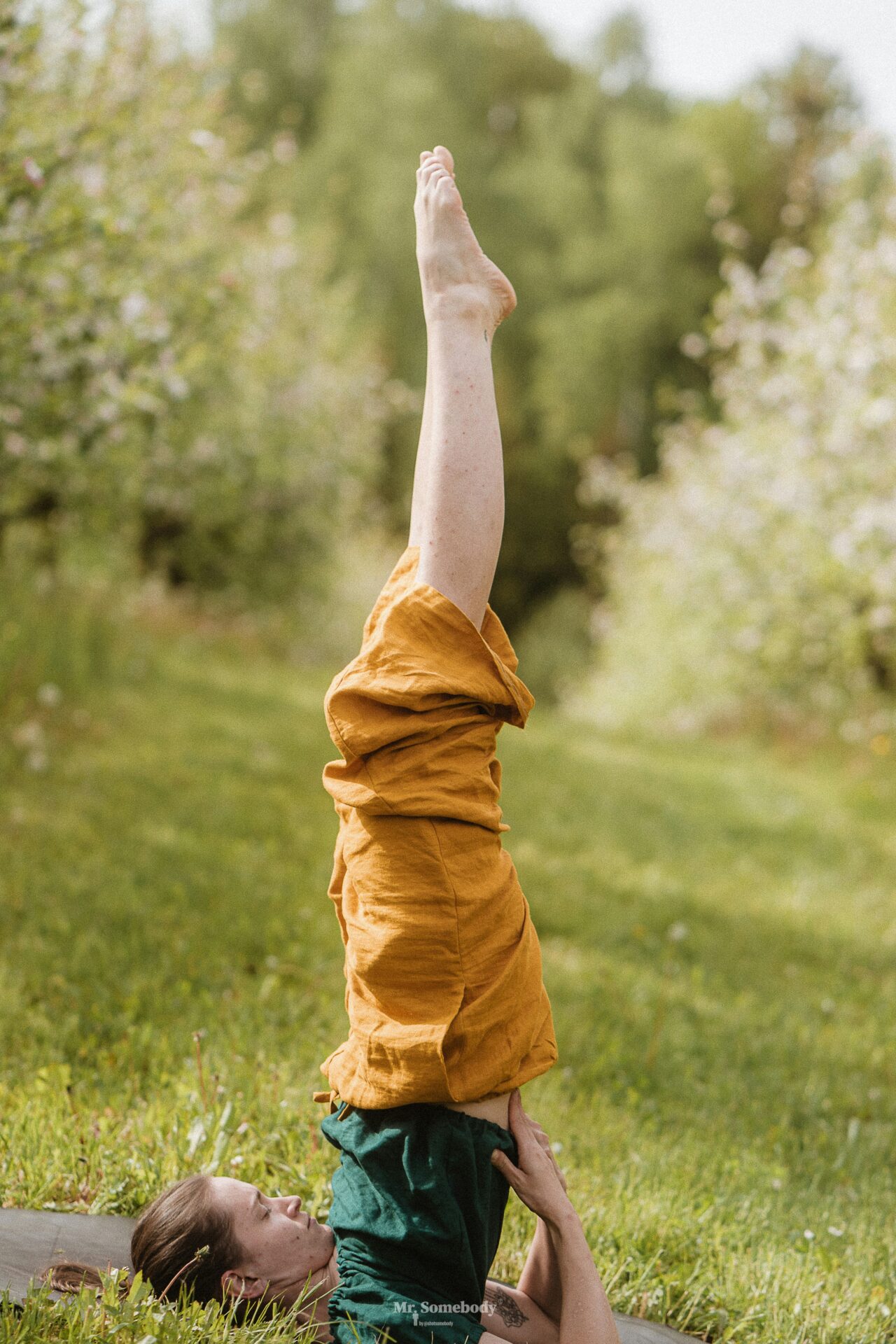
Vipareeta karani asana is an inverted posture that counteracts gravity and the aging process. From the lying down position one hikes up their legs so that the legs are up in the air, soles of the feet facing the ceiling. The hands are holding the pelvis underneath, on either side. The body is resting on the shoulder blades, upper arms and elbows. Caution that the neck and head are free and feel light. The inversion of the legs has many benefits for the lymphatic and circulatory systems, and the brain receives more blood and nutrients. The strength and stamina required to maintain the position strengthen the nervous system, increase the prana and mental will-power and determination.
9. Siddhasana (accomplished pose for men)/ Siddha yoni asana (accomplished pose for women) or Sukhasana (easy pose)
The ability to sit in a steady and comfortable position for some duration of time is essential so that the body, energy flows and mind can settle and become quiet. Once physical discomfort and energetic and mental agitations are alleviated, then the practitioner can focus on pranayama practices or turn their attention inwards to explore the workings of their mind.
Siddhasana (for men) or Siddha yoni asana (for women) are basic sitting postures with the legs crossed. The one heel is positioned to apply pressure at the pelvic floor at mooladhara (root) chakra and the other is placed on top in a way that stabilises the position.
Another alternative position which creates a balanced triangular base is Sukhasana. This is the familiar simple cross-legged pose we often use. All these postures train the spine to be naturally directed upwards, the back to be straight and the chest open. The legs are ‘locked’ into position so that minimum effort is required to maintain the posture.
10. Shavasana (corpse position)
Finally, no ‘top 10’ list would be complete without the position of Shavasana, the corpse pose. Lying on the back with feet slightly apart, hands alongside the body with palms facing upwards, and head in line with the spine. Allowing the physical body to completely let go and surrender all its weight to the floor, and abandon any sense of effort. Shavasana is the main relaxation pose for all practitioners who are comfortable lying this way. In this position the energy body is opened and the flows aligned. Mental relaxation is also easier, since the physical body is still and relaxed.
Lying in shavasana for a few minutes of conscious relaxation practice daily has profound effects on releasing musculoskeletal tensions, releasing pressure on the inner organs and balancing the autonomic nervous system. Numerous breathing practices can be performed in shavasana which deeply effect the pranic and mental bodies. Even being aware of one’s natural breath for a few minutes in shavasana can improve one’s quality of life immensely.
For more asana sessions with Satyanandashram Hellas visit our YouTube channel: https://www.youtube.com/c/SatyanandashramHellas/playlists