







Updated on 22/12/2025
The greatest lesson we have to learn is the lesson of life. And this becomes available to us when we decide to step out of our routine existence and adopt some different ways to live by, even if it is for a short time. One of these ways is ashram life, where you can stay for a few days as a sannyasin and live a life that is diametrically opposite to yours and learn how to deal with different situations, different people, and different problems and, at the same time, also learn to deal with yourself. Both children and adults should have this experience. Children, however, will gain more from this experience as their acceptance of the ashram is simple and straight from the heart.
Swami Satyananda Saraswati
What is an ashram?
Ashrams are not a modern-day concept but one that stems from an ancient tradition in India, which can also be traced back to ancient Greece and elsewhere. India, however, has been able to preserve this ancient culture over the passing of time, and for this reason ashrams still exist today.
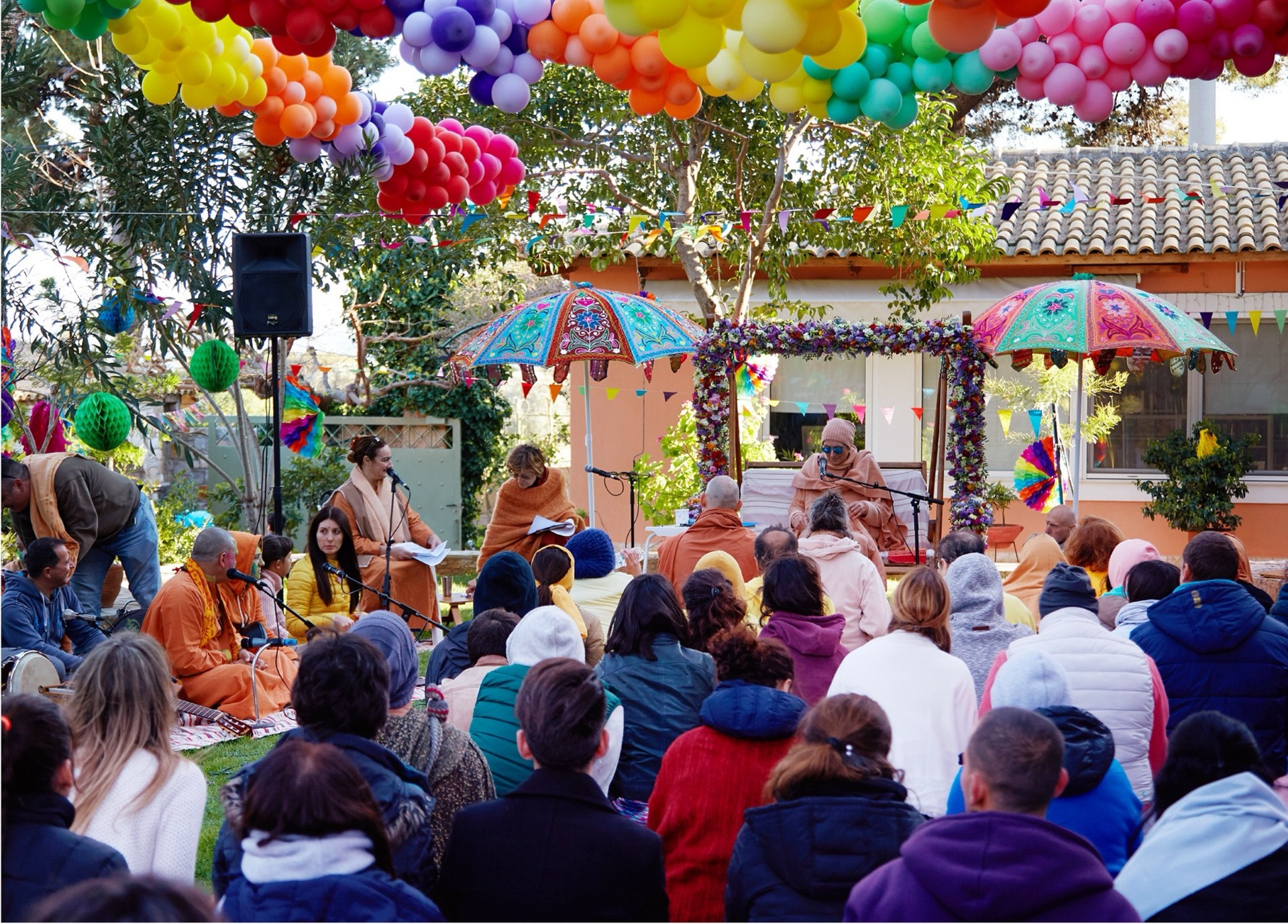
Satyanandashram Hellas was established in 1971 by Swami Sivamurti Saraswati, Yoga Acharya (Master). It is based in the foothills of Mt. Ymittos, just outside Athens in the township of Paiania and is a non -profit organisation whose aim is to spread Satyananda Yoga in Greece as well as support the philanthropic work of SATYANANDA MATH-Amba. Inaugurated by Sri Swami Satyananda Saraswati, one of the great luminaries of the previous century, in 1985, he named it the "True-Bliss Ashram" and envisioned a place where people could work together and live together with a spirit of utter selflessness."
It is a spiritual community, as well as a place to put your energy to good use overcoming and transforming laziness and weakness into creative dynamism as the word itself is derived from the Sanskrit root 'shram' which means hard work. Sri Swami Satyananda Saraswati describes an ashram as a place where one works hard on the physical plane to transform the energies of the mind.

Can anyone live in a yoga ashram?
People from every walk of life come and live in the ashram for a period of time, away from the distractions of their current lifestyle to imbibe the principles of yoga, while learning to live free of any involvement or attachment. There is no caste, colour, creed, age or gender barrier. In the olden days, in fact, Kings and ordinary people lived together in ashrams.
What to expect while living in an ashram?
Waking up early
Waking up just before sunrise is a special time when there is a great deal of prana (life force) in the atmosphere. An ideal time to do one's personal sadhana (spiritual practice), to have a yoga class and to practice breathing techniques or meditation. This habit maintains good physical health, clarity of mind and instils a sense of peace and harmony.
Ashram diet
The food is seasonal, mostly organic vegetables and fruit grown by the ashram in a field close by. It also includes pulses, flour, condiments, seeds and grains as well as tea. Light and easy to digest, simple with a few condiments added, the meals are freshly prepared in a community spirit. Occasional fasting is also followed. Most important is the attitude we have to food, which is treating it as prasad; a blessed gift one receives through the grace of God.
Shared responsibilities
The ashram is run by seva yogis (volunteers) and visitors who come to the ashram to live and work in the spirit of Seva Yoga; lending a helping hand while at the same time experiencing the benefits of offering selfless service. All activities are communal: the cooking, the cleaning, the gardening, the maintenance, the management and so forth.

Seva is an important component of the ashram culture. It has been translated into English as service, but seva means the final stage of human engagement with the world while in a higher state of consciousness. The literal meaning of the word seva is "to be with it", saha eva. Be with what? Be with that which is human, compassionate and loving. In other words, seva means connecting with the divine, transcendent nature and expressing that nature in thought, word and deed.
Swami Niranjanananda Saraswati
The need for an ashram today for spiritual growth and discipline
The ashram is an ideal place to stay and recharge yourself by stepping out of your normal life and living not just for yourself. This, in itself, gives you a new vision and concept, which is full of promise and confidence in yourself.
An ashram has a definite role to play in today's world since it provides people with something that is not easily available in modern society. One comes here to attain balance in the different facets of their personality. The head, the heart and the hands must synchronize if you want to realise your goals whether they are material, spiritual or both. The ashram provides a suitable environment for this metamorphosis to take place as the lifeline of the ashram is spiritual.
One learns to stand back from daily occurrences that could otherwise create pain and dissatisfaction and learns to develop a more balanced, harmonious, positive and creative attitude by implementing anushasana, which is a discipline of a more personal and spiritual nature.
How does a typical day at the yoga ashram look like?
Depending on the season and various yogic celebrations, life on the ashram will vary. But, here is a general outline to get the feel of what a typical day may look like.
05:00 Wake up and do personal sadhana
06:30 Breakfast
07:00 Hestia (general Karma Yoga) where there is cleaning, and arranging exterior and interior spaces of the ashram grounds.
08:30 Departmental Karma Yoga assigned to individuals in administration, maintenance, publications, transcriptions, audio-visual library, arts and crafts, gardens, organic farming, kitchen, etc. and/or Yoga sessions according to current program
12:00 Lunch
13:00 Departmental Karma Yoga
14:00 Yoga Nidra of the Satyananda System of Yoga
14:30 Tea
15:00 Departmental Karma Yoga and/or Yoga sessions (as above)
16:30 Gardening and Tree pooja
17:30 Dinner
18:30 Evening program (where a video or film is shown, kirtan sessions or other activity)
19:30 Study or personal sadhana in one's own room
20:30 Lights out
Every Saturday there is the chanting of the Mahamrityunjaya Mantra and Havan (fire ceremony)
On Ekadashi (twice a month) there is the chanting of the Bhagavad Gita Path
Every 4th, 5th & 6th of the month Guru Bhakti Yoga -The Yoga of Remembrance is performed
Every 11th of the month SWAN speaks: Readings from Swami Niranjanananda Saraswati
Once a Month there is Satsang with Swami Sivamurti Saraswati
The role of Seva Yoga in the ashram
Karma and Seva yoga are two important components of ashram culture which the visitor has the opportunity to learn more about and experience during their stay.
Seva Yoga means “the yoga of selfless service.” The word Seva in Sanskrit means service performed without expecting anything in return. It isn’t a separate style of yoga but rather a spiritual practice within Karma Yoga, focused on transforming yourself through acts of kindness and service. It is volunteering your time and energy to helping others without ego or expectation; staying present and loving in your actions, and cultivating compassion and humility.
The purpose of Seva Yoga is to develop a deeper sense of connection with others and to turn everyday actions into spiritual practice.
The priority of Seva is others. It is when we offer something from our hearts and cultivate a positive attitude, doing things to uplift others and the situation at hand.
Some examples are cooking and feeding the homeless, running yoga classes for certain vulnerable groups in society (cancer patients, prison inmates, the elderly, battered women etc.), offering your skills to your community, caring for the environment, like cleaning a local park, or helping a friend or neighbor without expecting anything.
Swami Niranjan explains to us that seva is not social service. Seva is honouring the divine within you. It is Atmabhav- when I am able to see myself in other people and serve them with that respect and honour. [1]
[1] Swami Niranjanananda speaking at Impact of Adi Shankaracharya’s teachings on Indian culture, Vedanta Bharati, https://www.youtube.com/watch?v=lr5diCfUS4g&t=240s
What are the benefits of ashram life?
Satyanandashram Hellas has been organizing the Ashram Life Experience for individual visitors for over 30 years offering one the opportunity to experience ashram life first-hand.
The emphasis of Ashram Life is on Seva Yoga. Through the practice of Seva Yoga you will discover the deep facets of your personality and learn how to deal with yourself, other people and different situations whilst simultaneously being active and efficient in life.
In the ashram, you learn to live yoga from moment to moment and yoga becomes a 24-hour living experience and a lifestyle that develops and transforms your personality and awakens your innate human potential, creativity and self-awareness of who you really are and what your purpose in life is.