



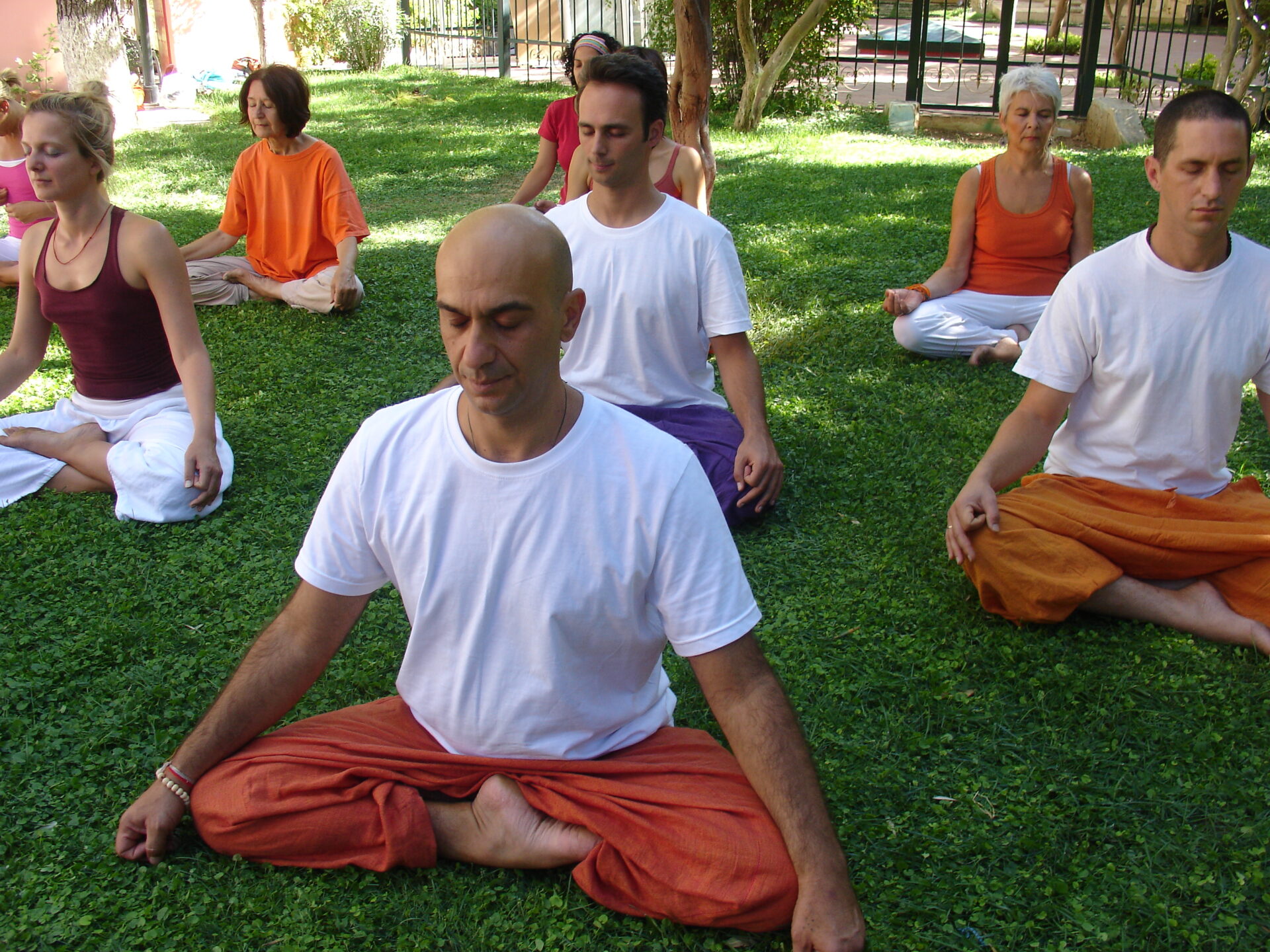

Read our article to learn more about the process of preparing for meditation; what are the best yoga poses for relaxation, and why use yoga for relaxation?
"In the case where you agree that meditation is a science of mind and not a science of God. If you agree that meditation is a system for the reorientation of human personality as a whole and not a meta physics. And if you agree that meditation is a system through which we can root out the individual plan, the unseen afflictions, the tensions that are around us, in muscular body, mental body and emotional body, then let us go ahead with the subject." [1]
Sri Swami Satyananda Saraswati, one of the greatest yoga masters of the previous century, speaks here to yoga aspirants about meditation. It is one of the most enlightening talks he gives as he clarifies what meditation is and isn't and how to accomplish it.
Why practice relaxation for meditation?
Sri Swami Satyananda conveys that meditation is a system by which the practitioner can rid themselves of the physical, mental and emotional tensions while simultaneously discover the deep-rooted psychological processes that limit us from evolving and be able to rectify them. In his talk he tells us that if meditation is to be achieved, the first process needs to be relaxation. He clarifies that it is not the "feel good" relaxation performed in countless yoga classes around the world, but what the ancient sage Patanjali calls Pratyahara.[2] Sri Swami Satyananda explains in his commentary in the Four Chapters on Freedom that to achieve pratyahara, we need to withdraw the senses from their attraction and their attachment to external sense objects. We know that the senses carry stimuli to the brain where the messages are relayed and the motor organs are automatically stimulated, whether we are conscious of it or not. This causes us to identify with whatever thought or emotions or whatever is happening around us and of course this results in us being very alert and extroverted due to the motor activity, but it is very difficult to relax in this situation. It is only in the state of pratyahara that the mind quietens. When pratyahara arises, the senses are disengaged and their connection with the cerebral cortex becomes disassociated allowing no messages to get through into the motor organs, and so the mind becomes calm and tranquil. When we can do that, we free the senses so that they can follow the mind inside, then the senses no longer control the mind because the mind takes control by restraining them.
Kaya Sthairyam: relaxing the body and mind to prepare for meditation
In the Satyananda Yoga tradition, Kaya Sthairyam is a technique where you consciously practice steadiness and stillness in the meditation pose you have chosen before moving into a meditation practice. Kaya means body and Sthairyam means steadiness. When we intentionally make the body motionless and steady, the breath immediately becomes more balanced, and in turn, this will introvert the mind making it calmer. As body consciousness is gradually lost through the practice of kaya sthairyam, it is possible to concentrate on higher practices such as meditation.
In Swami Niranjanananda's book Prana, Pranayama, Prana Vidya
which is a comprehensive guide with a multitude of techniques from beginners to very advanced, you can also find the technique of Kaya Sthairyam (p.239-240).
How to prepare for meditation?
Find a quiet space and suitable time
Sitting down at a particular place and time every day will help with creating regularity in your meditation practice. The space you choose needs to be clean, well-ventilated but make sure you do not sit in a draught or under a fan. The best time to meditate is early morning or just before going to bed. The perfect time is 4.00-6.00 in the morning known as Brahmamuhurta ideal for spiritual practices due to the perceived auspicious energy and lack of distractions in the environment.
Remember not to meditate immediately after a meal, but allow 4 hours to pass as attention is drawn to the stomach for digestion creating a distraction.
Be regular! Even ten minutes of meditation every day is most beneficial. Slowly you can then extend the time; but regularity is of utmost importance.
Calm the body with a breathing technique
The best and most direct method to adjust the energy flows in the body is practicing pranayama. The main effects of pranayama are felt in the nervous system and in the pranamaya kosha (the subtle psychic energy body). Pranayama prepares the body to become still and mind to be introverted.
- Nadi Shodhana pranayama (psychic network purification) has a few stages that need to be practiced properly and mastered before moving onto the next stage. For a comprehensive guide to nadi shodhana you can read Meditations from the Tantras by Sri Swami Satyananda Saraswati pages 138-148.
- Brahmari pranayama (humming bee breath) relieves cerebral tension, removes anger, anxiety and frustration, and lowers blood pressure preparing the body and mind for relaxation and meditation practice. You can find detailed instructions of brahmari in the Asana, Pranayama, Mudra, Bandha book.
Make an intention
There has to be clarity of intention as to what you want to achieve. Swami Niranjanananda shows us that without an intention you will not achieve much, but rather you will be going around in circles. Many people (including those who have never done yoga) decide that they want to meditate, but when asked why, they really can't tell you. They do not have a clear purpose. They may have heard or read somewhere that meditation is good and brings benefits, and so they decide to do meditation. But this is rather vague. So, first, the intention has to be defined. For instance, your intention might be to have better memory, to have clarity of mind, to be able to focus, to be able to manage negativity or difficult emotions that overwhelm you. These are just some examples.
Once the intention is clear, then a path can be mapped out and your yoga teacher can guide you in the right direction, moving you gradually towards your goal.
What are the best asanas to prepare for relaxation and meditation?
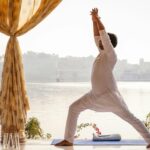
The aim of all physical poses chosen to prepare for meditation is to enable the practitioner to sit completely still for a period of time without any physical discomfort. The steadier you are in your meditation pose, the more one-pointed and less distracted the mind will be. To loosen up the joints and to free the obstructed prana, the best asanas to do are the Pawanmuktasana series 1-3. More specifically, Sri Swami Satyananda recommended goolf chakra (ankle rotation), janu chakra (knee crank), ardha titali asana (half butterfly), shroni chakra (hip rotation) and poorna titali (full butterfly). Also, vayu nishkasana (wind releasing pose), udarakarshanasana (abdominal stretch pose) and shaithalyasana (animal relaxation pose). Asanas that relax the spine such as tadasana (palm tree pose), tiryaka tadasana (swaying palm tree pose) , katichakrasana (waist rotating pose), any forward and backward spinal bends, as well as vipareeta karani (inverted pose) will help you sit more comfortably when doing meditation.
After these asanas you can choose a relaxation pose such as lying in shavasana (corpse pose). This pose develops body awareness. When the body is completely relaxed, awareness of the mind increases, developing pratyahara.
Meditation poses that you can take are:
- Sukasana (easy pose)
- Ardha padmasana (half lotus pose)
- Padmasana (lotus pose)
- Siddhasana (accomplished pose for men)
- Siddha yoni asana (accomplished pose for women)
- Swastikasana (auspicious pose)
- Dhyana Veerasana (hero's meditation pose)
- Vajrasana (thunderbolt pose)
- Ananda madirasana (intoxicating bliss pose)
- Padadhirasana (breath balancing pose)
- Bhadrasana (gracious pose)
It is important to take note that your knees, ankles, hips and spine feel comfortable and there is no pain or discomfort in any part of the body. Do not use undue force on any account and always find the best pose that will enhance your meditation practice.
Each person is different, and needs to take care of their body's needs, this is why props should be used (cushions, blankets, yoga blocks), sitting in a chair or leaning against a wall to alleviate any pain or discomfort in any of the poses or asanas you do.
Visit our You Tube channel at Satyanandashram Hellas and experience the beauty of meditation practices. (https://www.youtube.com/c/SatyanandashramHellas/playlists)
[1] http://www.yogamag.net/archives/1970s/1976/7601/7601med.html
[2] Ibid.