





Satyananda Yoga Nidra® is a very powerful practice derived from the Tantras, which go back thousands of years. With this practice one learns how to relax the mind consciously. It’s a state of dynamic sleep, but you do not actually sleep. In fact, sleep is not considered to be relaxation according to yoga. So, what is relaxation? Most people think that relaxation is having a drink at the end of the day or lighting up a cigarette or collapsing into a comfortable armchair to watch television or scroll through social media. Others believe that the only way for them to relax is by taking a few tranquilizers. Yet, none of these forms will ever suffice as a scientific definition of relaxation. These are simply sensory diversions and they only bring temporary relief from tension. Tranquilizers and the like, cannot remove the root cause of tension, but only treat the symptoms.
Yoga nidra, could be seen as a yogic 'tranquilizer' as it’s a natural method of relaxing the mind and body. Real relaxation is an experience where one must remain aware, awake, and conscious and be far removed from any experiences that are coming from the senses. Relaxation is a subject that’s spoken about extensively, yet very few people are actually able to experience relaxation, as almost everybody is facing tension: muscular tensions, emotional tensions, and mental tensions. Due to this inability to allow the body, mind, and emotions to relax, we’re now being confronted with a variety of stress related disorders, such as diabetes, cardiovascular disorders, hypertension, or migraine, asthma, ulcers, digestion disorders, skin diseases, and cancer, that arise from the tensions in the body and the mind.
Continual tension and stress interfere with the workings of the physical organs and cause them to systematically break down. However, in yoga nidra, mental tensions are removed by relaxing first the conscious mind and then the deeper realms of the subconscious mind, leading to amazing changes taking place in relation to one's health. It is the subconscious mind that is basically controlling all the functions of the body. If we have great amounts of tension in the realms of the subconscious mind, how can there be harmony and balance in our bodily functions? It’s impossible. A mind that’s free from mental and emotional tension allows the physical body to perform its duties unimpeded. For this reason, the more we’re able to remove tension from the mind, the less vulnerable we’re going to be to any onset of disease. The seed lies in the mind, it’s born in the mind, and we see the results in the body.
Sri Swami Satyananda said that a vast number of diseases, such as cancer are born of the mind and manifest in the body over a long period of time. Many diseases are caused primarily by mental tension and also by suppressed feelings or suppressed emotions. Sri Swami Satyananda spoke about this in the previous century by saying that, “the International problem today is not hunger, poverty, drugs, or fear of war. It is tension, hypertension, total tension. If you know how to free yourself of tension, you know how to solve your problems in life.”
Yoga philosophy, as well as modern psychology, enumerate three basic forms of tension that are responsible for most of the agonies of modern life. The first is muscular tension. It’s related to the body, the nervous system, and the endocrinal imbalances. These are easily removed by the relaxation attained in the state of yoga nidra. The second form of tension is the emotional, which stems from our inability to manage our emotional nature and remain balanced when we’re facing the main dualities in life, such as profit and loss, success and failure, praise and criticism, happiness and unhappiness, etc. Emotional tensions also stem from our inability to express our emotions freely and openly; most often we repress them. The more we repress our emotions, the more deeply rooted our tensions become, making it impossible to remove them through ordinary sleep or relaxation. Yoga nidra can, however, relax the entire emotional structure of the mind. Then, there are the mental tensions which result from excessive mental activity, over thinking, an inability to stop the ‘chatter’ of the mind and a tendency to think negatively. So, when we practice yoga nidra, especially if we practice it regularly, these three-fold tensions can be progressively released and removed.
The aim of yoga nidra
Yoga nidra is a scientific method of removing these three-fold tensions in a systematic way. The aim of yoga nidra is to reach that state of mind between wakefulness and the dream state, where we stay on the borderline between being awake and actually slipping into a more subconscious or unconscious state. It’s not easy to do. Some people can actually be sufficiently conscious and aware to catch the moment when they’re moving from being awake to going into a dreaming state. Others can’t. The subconscious and the unconscious mind are the most powerful forces in the human being. Sri Swami Satyananda once said to me, “If you can control the mind, you can do anything, and if you can control the uncontrollable in the mind, then you are a guru.”
In his book Yoga Nidra 1he says, “the subconscious mind is a very obedient disciple and immediately carries out the orders that you put to it. If you know how to practice yoga nidra, you can train your subconscious and unconscious minds completely. Then the ordinary mind will follow suit. Yoga nidra is the science of relaxation, which enables each of us to dive into the realms of the subconscious mind, thereby releasing and relaxing the tensions and establishing harmony in all facets of our being.”
How Sri Swami Satyananda discovered yoga nidra
When Sri Swami Satyananda was a young disciple, living in Rishikesh at his guru's ashram (1943-1956), Sri Swami Sivananda, asked him to go to a neighbouring ashram to be the night watch where he had to watch over sannyasins till four o’clock in the morning and then he was allowed to go sleep. So, around about four o’clock, the sannyasins would wake up and start chanting Vedic mantras while Sri Swami Satyananda went to sleep. This continued every night for about six months and at the end of six months, he returned to his guru’s ashram. About a year later, he heard these same chants in his guru’s ashram but he could not recall ever having heard them before, let alone learning them. Nevertheless, he knew all the chants. So, he went to Sri Swami Sivananda and mentioned that the chants were so familiar to him even though he could not remember having learnt them. Sri Swami Sivananda replied by saying that the chants had been chanted at the neighbouring ashram for the six months that Sri Swami Satyananda had been doing the night watch. This was a total eye-opener for Swami Satyananda. In his book Sri Swami Satyananda writes:
This was a great revelation for me, I know that knowledge of yoga is transmitted directly through the senses, but from this experience I came to the conclusion that you can also directly gain knowledge without any sensory medium as well. That was the birth of yoga nidra.
He then reconstructed his way of understanding the learning process because he realised that learning is not simply acquired through the five senses when one is awake. Obviously, while one is sleeping and unconscious there is something still awake within one that is able to learn and pick up information from the surroundings. And it was that which instigated his research into the ancient texts where he came across the practices of yoga nidra from nyasa.
Yoga nidra can be done by everyone
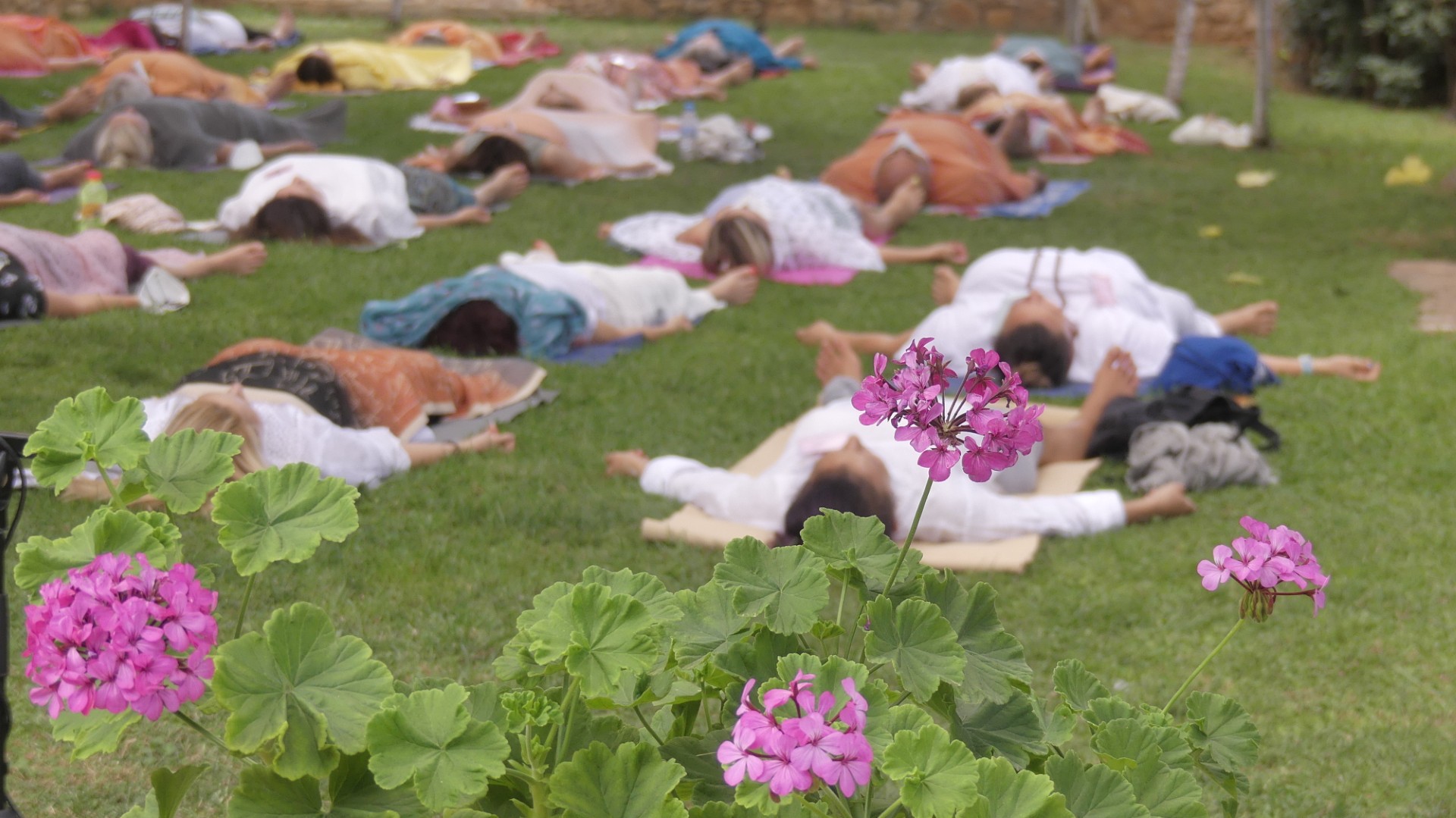
Let’s now look closer at the components of yoga nidra. There are different techniques for people suffering from hypertension, cancer, and other problems. And of course, there are also techniques in yoga nidra for those who want to go deep into the more spiritual side of yoga. It’s actually a very simple practice which can be learnt even from a recording. The practice itself generally lasts 20 to 40 minutes. Basically, in yoga nidra, you’re asked to lie down in a very comfortable position. If you find this difficult, you can do yoga nidra reclining in a chair. In fact, you just need to get into a position where your body feels relaxed and then follow the instructions.
To begin with, there’s a small preparation stage. Then, the practitioner is asked to make their sankalpa. A sankalpa is a resolution or a resolve that is repeated during the practice of yoga nidra. One has to be very precise and clear on how they form their sankalpa. It also has to be reasonable, that is, it has to be acceptable to the subconscious mind otherwise, it will not penetrate into the subconscious. Sankalpas need to be formed in the affirmative present tense or the present continuous tense, for example, “I am in the process of achieving total health” or “I awaken my spiritual potential”, or “I am a positive force for the evolution of others”, or “I am successful in all that I undertake.” The sankalpa is said with the exact same words every time during the practice. The next stage is the rotation of consciousness. Here you are required to follow the instructions and be aware of each point of the body that is referred to by the instructor. Then, there’s awareness of breath, followed by perhaps an awareness of different feelings and sensations. A visualization comes next, and then, the repetition of the sankalpa once again with the exact same words. The final stage is ending the practice.
What’s important is that you do not intellectualize while you’re doing the practice. If you miss an instruction, don’t worry about it, it doesn’t matter, just follow the next instruction because as you go into a deep relaxation, often you’ll find your mind will wander and then it might come back to the instructions. This might happen several times throughout the practice. You might feel concerned that you’re missing part of the instructions. However, don’t let that worry you. When this happens, and you become aware of it, just follow on with the instructions that are being given at the present. Try not to sleep. Of course, many people do fall asleep in yoga nidra. The information that’s being given still goes into the subconscious mind but the real benefits of yoga nidra are lost. Your aim is to catch that borderline between being awake and falling asleep. It’s in that state that there’s full muscular relaxation and it’s in that state that the emotional tensions and the mental tensions can slowly begin to release themselves.
The amazing benefits
- It relaxes the whole physio-psychological system of the body and thereby rejuvenates both the body and the mind.
- It reduces our need to sleep; one hour of yoga nidra is considered to be parallel with four hours sleep.
- It brings about sleep in cases of insomnia.
- It induces a state of well-being and joy, which just bubbles up from within, and we feel good with ourselves.
- When used as a therapy, it can remove fears, complexes, phobias and inhibitions.
- It enhances the learning process.
It induces the state of pratyahara, where we prevent external perception and as a result our perception is internalized. We learn to identify with the drashta (the objective witness) and observe the contents of our mind with non-attachment as well as allowing us to perceive the different layers of our mind.
Yoga nidra is a process of gradually coming into touch, into connection, and into communion with our true Self. It is a veritable tool for transformation.
Download the Satyam Yoga Prasad app for free and enjoy the Satyananda Yoga Nidra® sessions at https://satyamyogaprasad.net/audio/audiopractices?prop=audio